
Churches hold a unique place in Malagasy society. Their influence, combined with the electoral potential represented by their followers, makes them coveted partners for political actors.
It is a constant: Churches have always been at the center of political desire in the country. Their social and cultural influence, their presence in even the most remote localities, and their ability to unite a significant number of followers make them highly sought-after interlocutors. For political leaders, they represent both a moral endorsement and a potential bridge to a large segment of the population.
The decision to entrust the Malagasy Council of Christian Churches (FFKM) with leading the national dialogue is a clear illustration of this. The four main Christian denominations within the FFKM possess a quasi-institutional legitimacy. In a context of political refoundation, their involvement also gives the process a moral and consensual dimension that the authorities seek to preserve.
However, this proximity is not solely about spirituality. For political actors of all stripes, courting the Churches is also a matter of influence. They likely believe that gaining the sympathy of religious leaders can improve their image among the faithful. Beyond electoral stakes, there is a goal to strengthen their popularity within the population. The current power holders are no exception to this rule.
Colonel Michaël Randrianirina, Head of State, Prime Minister Mamitiana Rajaonarison, and National Assembly President Siteny Randrianasoloniaiko, among others, have been making frequent appearances at religious events recently. Several government members and parliamentarians often accompany them. They participate in services of both the FFKM denominations and the so-called “junior churches,” a politically correct term used to designate other Christian movements.
The stakes are high, as some of these “junior churches” have a strong mobilization capacity. The relationship between preachers and their followers can be particularly close. Hence the idea, present in some political circles, that a voting or political instruction given by a religious figure could influence the electoral behavior of their followers—a hypothesis that makes certain religious leaders highly courted individuals.
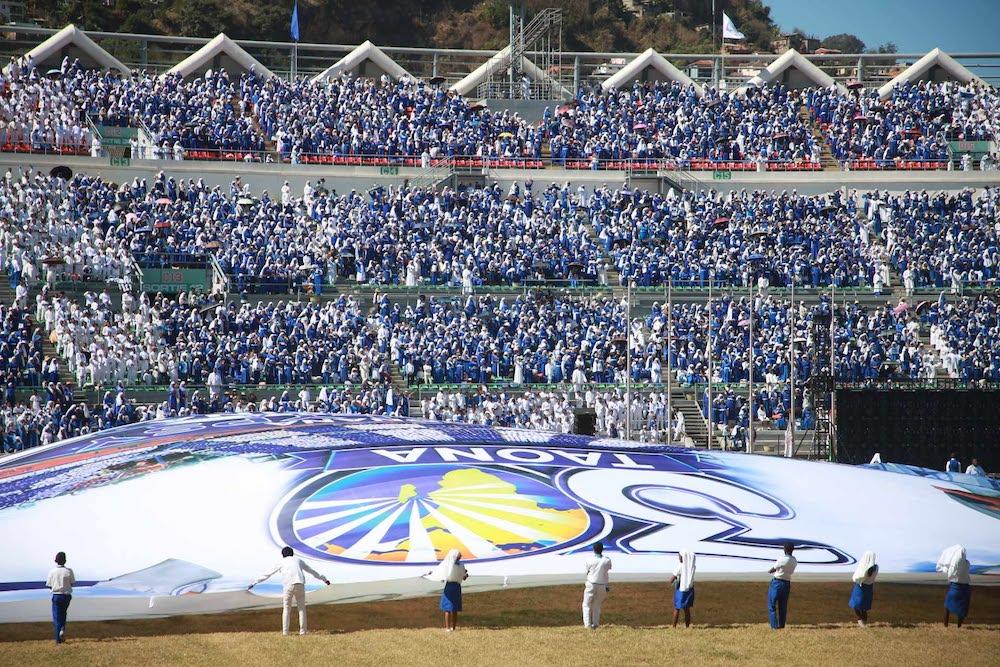
On Saturday, August 8, the Head of State and the President of the National Assembly attended the “Apokalipsy” Church service at the Barea Stadium in Mahamasina before a massive crowd. In his speech, Michaël Randrianirina highlighted his Christian faith and his membership in the “Mpiandry” order of the Lutheran confession—laypeople committed to the service of faith. On this occasion, the Iavoloha resident donated 40 million ariary to the Church.
A week later, the President of the National Assembly attended the “Vahao ny Oloko” Church service at the Antsonjombe Coliseum, where he also made a donation. On Sunday, the Prime Minister was present at a religious gathering in Manolotrony. First Lady Elisa Randrianirina has also joined this dynamic; through her Fanjiry Foundation, she provided food and financial donations to the Lutheran Women’s Association gathered in Toliara over the weekend.
The Head of State and the Prime Minister do not miss opportunities to wear their “Mpiandry” robes during public services. This strategy of courting the favor of Churches and their followers is not new. Previous administrations also multiplied gestures toward religious organizations. In most cases, these actions are presented as acts of devotion or marks of support for faith, social action, or charitable works.
To some extent, given that religion retains considerable influence in the country’s social life, proximity to the Churches seems to be a political investment. This closeness between political actors, especially state officials, and religion often sparks debates about the scope of the state’s secularism as prescribed by the Constitution.
“The State affirms its neutrality with regard to different religions. The secularism of the Republic is based on the principle of the separation of State affairs from religious institutions and their representatives. The State and religious institutions are prohibited from any interference in their respective domains. No head of an institution or member of the Government may be part of the governing bodies of a religious institution, under penalty of being removed by the High Constitutional Court or dismissed from their mandate or function,” the Fundamental Law states on the subject.
Captured & Published at: 2026-08-18 06:08:59 (Madagascar Local Time EAT)
Original Source: https://www.lexpress.mg/2026/08/conjoncture-les-eglises-au-centre-des.html