
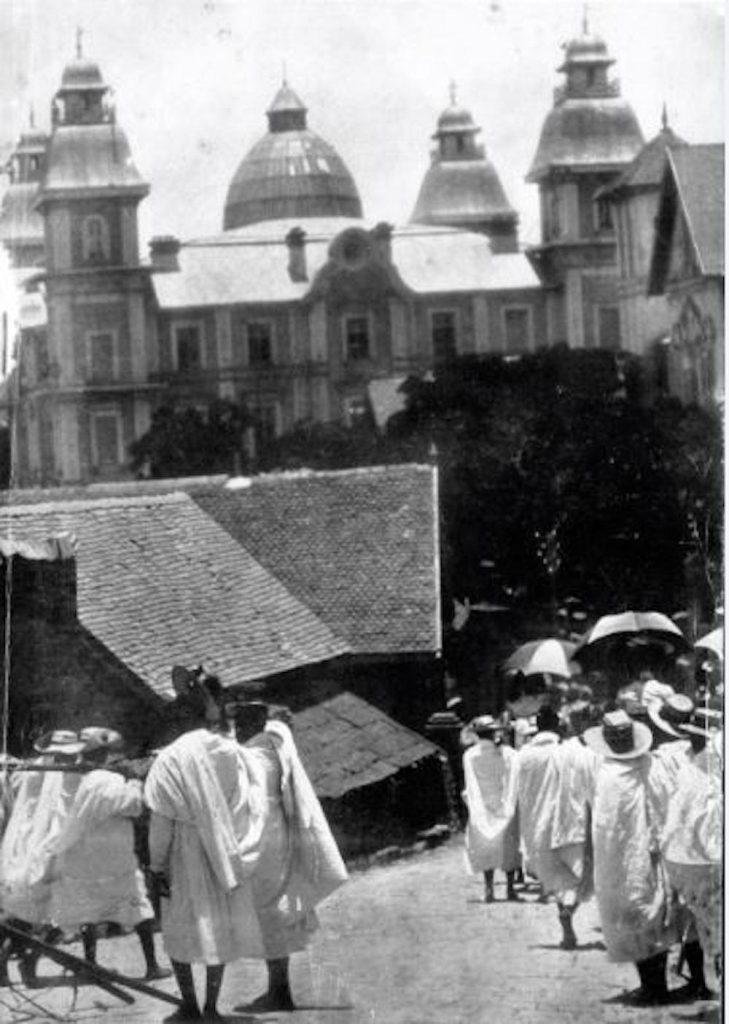
A pervasive plague, a supernatural curse, prophylaxis considered a sacrilegious behavior, and fraud through clandestine burials and exhumations to respect traditions… This summarizes the first part of the study conducted by researcher Faranirina V. Esoavelomandroso, titled ‘From Plague Disease to Political Plague: Interpretation by the Merina of the Plague Endemic Phenomenon on the Central Highlands (1921-1936).’
In the second part, the author points out that ‘in this atmosphere of terror and the specific context of colonization, with the inequality and oppression the system implies,’ the idea of a disease ‘invented’ by the French administration quickly took hold in the minds of the Merina. Beyond mere credulity, the hope of purchasing a ‘good diagnosis’ was justified by the belief that while the disease might exist—a fact not always accepted by Malagasy people—it was harmless, given ‘the comedy of prophylactic measures’ denounced by Paul Dussac in ‘La Nation Malgache’ on December 6, 1935.
Since one of the colonizers’ official justifications was to ensure the well-being of the natives through effective social policy, ‘the anti-plague struggle reflects the inconsistencies, the arbitrary nature, and the limits of medical and sanitary action,’ the author notes. Living in a profoundly unequal society, Malagasy people interpreted legitimate prophylactic measures as ‘pretexts seized by the colonial power to make them feel their total subjection.’
Faranirina V. Esoavelomandroso explains this opinion, first, through plague-related provisions that increased the burden of colonial control over the population. Accompanied by European police officers representing superior authority, ‘mpiadidy’ (notables) and indigenous governors were ordered to patrol their neighborhoods, question residents, and ‘visit houses to report to doctors all those with sick people, as well as any deaths they found suspicious.’ For the locals, such control infringed upon family privacy.
Secondly, movement was tightly monitored. Militiamen guarded the sanitary cordon surrounding important centers. The author cites nationalist leader E. Razafindrakoto, who in his autobiography compared the capital in 1921 to a besieged city held by ‘Senegalese’ soldiers—the terror of Malagasy people during the colonial era—who were armed and ready to fire on those ‘escaping’ the contaminated zone.
Going further, he saw in this measure a desire by colonizers to prevent contact between Malagasy people. He thought the situation of the colonized could be compared to that of defeated Germans during World War II: ‘Because of the sanitary cordon, the Malagasy cannot communicate with each other; because of the Berlin Wall, the Germans were cut off from one another.’
The historian interprets this ‘extreme comparison’ as the painful impression left by the plague in the memory of the Merina. Indeed, severe and arbitrary sentences—ranging from a few days in prison to years of forced labor, or even immediate armed repression—befell those who attempted to leave the contaminated zone clandestinely. Within the capital, neighborhoods hit by the epidemic were isolated by barbed wire networks.
‘This was an inconvenient measure, as family members could not visit their sick or provide material aid, while the administration did not always prove effective in this regard.’ In the countryside, although less strict in appearance, the provisions were in reality more restrictive for inhabitants. ‘Members of the fokonolona had to ensure the surveillance of a cordon marked by a simple raffia string.’
Captured & Published at: 2026-07-08 07:13:02 (Madagascar Local Time EAT)
Original Source: https://www.lexpress.mg/2026/07/des-mesures-sanitaires-assimilees.html