
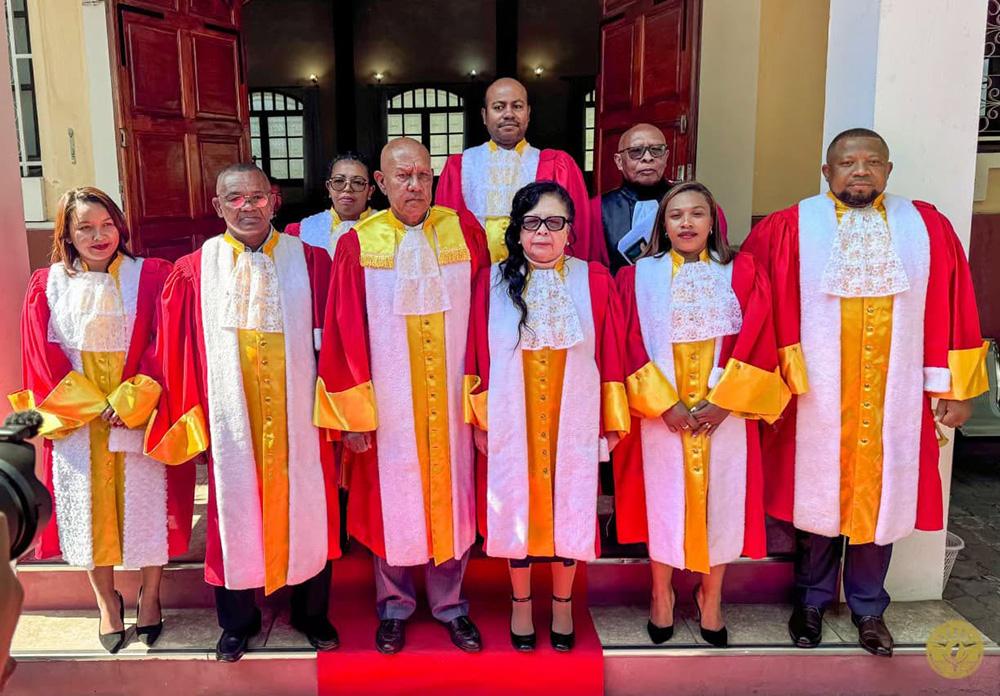
The High Constitutional Court (HCC) has halted a radical sanction provided for in the new text regarding the status of the judiciary. The automatic dismissal of magistrates convicted of corruption is deemed unconstitutional.
Not in conformity with the Constitution and must be removed. This is the decision of the High Constitutional Court regarding the final paragraph of Article 56 of the organic law on the reform of the status of the judiciary. An injunction issued in its decision published yesterday concerning the constitutionality check of this text.
The final paragraph of Article 56 of this organic law provides for the automatic dismissal of magistrates in the event of a final conviction for corruption or similar offenses. Beyond the status of magistrates and in relation to public interest, this was the flagship measure of the text adopted by the National Assembly on June 5. However, it is one of the only two provisions of this new law that the HCC invalidated and ordered to be removed.
“Any magistrate, regardless of grade, function, or position, who is subject to a final conviction for acts of corruption or similar offenses, as well as any magistrate sentenced by a final court decision to an afflictive or infamous penalty, is automatically and without the possibility of derogation dismissed from the judiciary,” provides the provision invalidated by the Court of Ambohidahy.
The High Court recalls, however, that the fight against corruption was one of the legislature’s objectives in drafting the text. “The judiciary is a fundamental pillar of the rule of law, guaranteeing justice, fairness, and the protection of citizens’ rights. However, in the current context in Madagascar, the image of justice has suffered from a loss of confidence, exacerbated by corruption cases, decisions perceived as biased, and procedural delays,” states the explanatory memorandum of the organic law.
The memorandum adds that “this observation highlights the need for profound reform to restore public confidence in justice. The ultimate goal is to guarantee accessible, equitable justice that respects everyone’s rights, thereby contributing to the consolidation of the rule of law in the country.”
Exclusive Jurisdiction
The Ambohidahy institution maintains that “while the fight against corruption, as claimed by the explanatory memorandum, constitutes a legitimate objective, it cannot be pursued by means that disregard constitutional requirements relating to the exercise of disciplinary power.”
The HCC bases its decision on the fact that the Constitution grants the Superior Council of the Magistracy (CSM) exclusive jurisdiction to rule on disciplinary matters regarding sanctions applicable to magistrates. “This exclusive jurisdiction implies that the Council has the power of discretion to choose the disciplinary measure proportionate to the facts submitted to it,” it explains.
For the High Court, by providing for automatic dismissal without leaving the CSM any margin of discretion regarding the choice of disciplinary sanction, “the contested provision deprives this body of any power to individualize the disciplinary measure, in violation of the exclusive jurisdiction that the Constitution recognizes to it in this matter.” The principle of individualization of sanctions implies that any disciplinary measure must be proportionate and adapted to the gravity of the facts.
Furthermore, the Ambohidahy institution considers that the automaticity thus instituted by the organic law gives the dismissal “the character of an accessory penalty attached by right to the criminal conviction, pronounced without an adversarial phase specific to the disciplinary procedure (…)”. Continuing its reasoning, the HCC emphasizes “respect for the rights of the defense [which] constitutes a fundamental principle recognized by the Constitution, (…) applicable to all disciplinary procedures.”
The HCC summarizes its decision to invalidate the final paragraph of Article 56 by arguing that “such a mechanism, in that it substitutes the mechanical application of the most severe sanction for the individualized assessment of the CSM, ignores the principle of individualization of sanctions, the exclusive jurisdiction of the CSM in disciplinary matters, and the rights of the defense.”
Captured & Published at: 2026-07-10 06:12:51 (Madagascar Local Time EAT)
Original Source: https://www.lexpress.mg/2026/07/condamnation-pour-corruption-la-hcc.html