
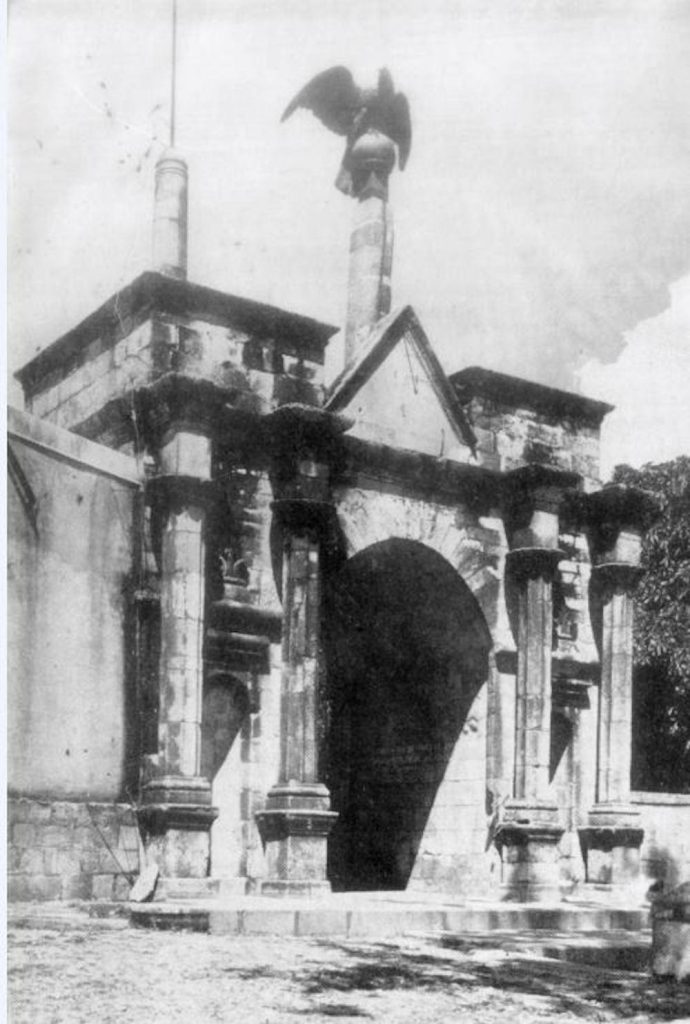
A witness to the historical evolution of a kingdom, the Rova bears the marks of the various stages of political construction; it is a historical document. But these marks are also inscribed in space, with the evolution of forms reflecting the various choices and influences that have shaped the country. The Queen’s Palace is also a history book. This is how Vincent Belrose Huygues begins his presentation of ‘The Rova of Tananarive, from Andrianjaka to Radama I: an example of aesthetic syncretism in the 19th century’.
Two centuries separate Andrianjaka and Andrianampoinimerina; the Rova of the former was transformed through expansion and additions. The author begins with a description of the Rova which, in a city or village, is the enclosure delimited by a wall or palisade, reserved for the sovereign or their representative. Within this enclosure stand the ‘Lapa’, the royal residences of the sovereign, their spouses, and their entourage.
Under Andrianjaka, only the southern Rova existed. In his work on the kings of Imerina, Father Callet notes: ‘This one was built first; that is where the ‘Tranomasina Fitomiandalana’ or the seven aligned tombs are located’ (Tantara ny Andriana eto Madagascar). One also finds the royal huts ‘Masoandro-tsiroa’ and ‘Besakana’. Conversely, the northern Rova is the enclosure built by Radama I around the ‘Tranomasina’, specifies the author.
Andrianjaka chose the highest point of the Antananarivo site (1463 m), the current terrace of the Palace Church. The king cleared the top of the hill then called Analamasina; the cut trees were used to build huts and a ‘Lapa’. To reconstruct the primitive Rova, Belrose Huygues refers to the only remaining landmarks, the ‘Tranomasina’. Until recently, they were located where Andrianjaka’s successors had placed them, because Andrianjaka’s tomb (the first one) was then installed 30 meters further south and a few meters east of the current wall of Manjakamiadana, the Queen’s Palace.
Architect Anthony Jully, in his 1898 work on ‘Housing in Madagascar’ (Notes, Reconnaissances et Explorations), which dates this translation to 1897, precisely records the previous locations, allowing the Rova buildings to be placed more or less where they were originally erected. Because apart from the tombs, ‘it is certain that all the buildings of the Rova have undergone displacements.’ Their old locations always sit in relation to one another.
Thus, starting from the ‘Tranomasina’, Belrose Huygues locates two huts of Andrianjaka’s Rova: ‘Masoandrotsiroa to the south of the ‘Tranomasina’ (…), Besakana is to the west of the great square and to the east of the cattle pen’ (Father Callet). However, according to the historian, ‘the ‘Kianja’ (great courtyard or arena), we learn later, is to the south of the ‘Tranomasina’.’ These two structures, like the huts that were supposed to surround them, have also disappeared.
Masoandrotsiroa was rebuilt by Andrianampoinimerina then moved to Ambohimanga by Ranavalona I. Subsequently, the palace was destroyed in a fire ‘at the time of the queen’s death.’ The historian specifies, however, that ‘Masoandro huts have constantly succeeded one another at the Rova, with each queen building her own.’ Regarding Besakana, tradition attributes its first construction to Andriamasinavalona. ‘These two Lapa were undoubtedly rebuilt by Andrianampoinimerina, to whom the structures visible today are generally attributed’ (that is to say, before the fire of 1995).
In Andrianjaka’s time, besides Besakana and Masoandro, a ‘Kianja’ with a sacred stone, the ‘Vatomasina’, and a cattle pen outside the enclosure were established to the west. His tomb was placed to the north, according to a custom generalized in Madagascar. ‘The Rova possessed the structures of all subsequent Rova until 1869-1888, when a temple was added. There was a structural ‘model’ of the Rova as early as the reign of Andrianjaka and, undoubtedly, long before.’ As Belrose Huygues specifies, the proof lies in the similarity of design and naming at the Rova of Ambohimanga and that of Antananarivo, ‘both restored by Andrianampoinimerina.’
Captured & Published at: 2026-07-02 07:12:51 (Madagascar Local Time EAT)
Original Source: https://www.lexpress.mg/2026/07/le-rova-dantananarivo-un-livre.html