
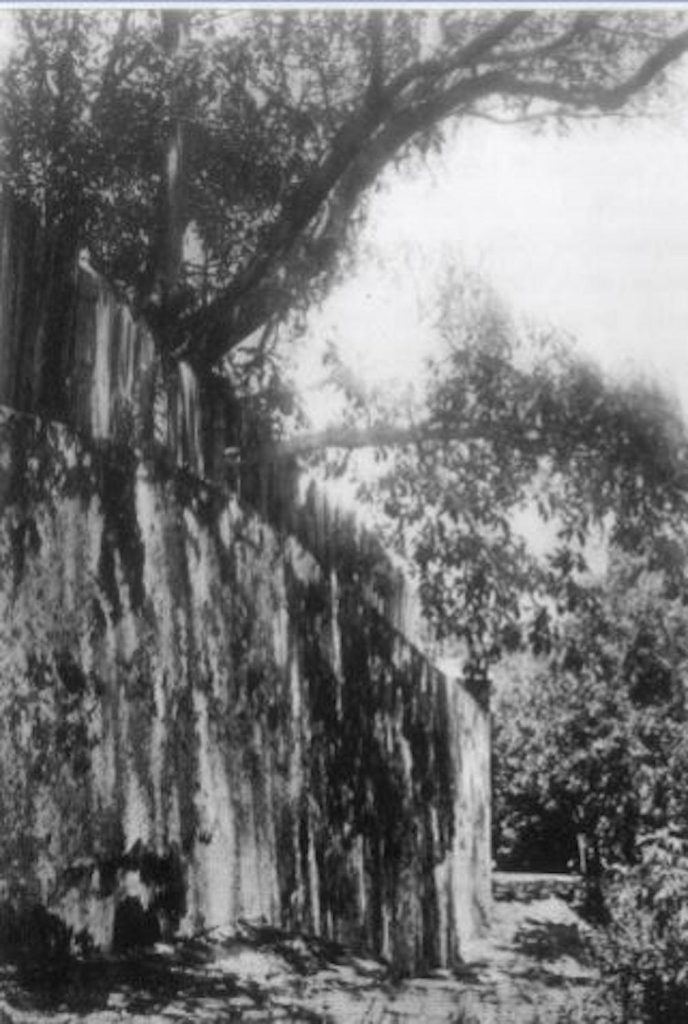
From the era of Andrianjaka until 1869-1888, when a temple was added, the Rova of Antananarivo possessed the structural characteristics of all preceding Rova. Vincent Belrose Huyghes cites Father Callet’s ‘Tantara ny Andriana eto Madagascar’ as an example: ‘In Ambohimanga, there are three enclosures: Mahandrihono, Nanjakana, and Bevato. They are separated from one another… arranged in terraces. The Tranomasina numbered twelve, forming a single row.’
Three essential functions are defined by the ‘Tantara’, notes the author of ‘The Rova of Tananarive, from Andrianjaka to Radama I: An example of aesthetic syncretism in the 19th century’. ‘Mahandrihono, inhabited by Andrianampoinimerina, and the Tranomasina are in the same enclosure; Nanjakana belonged to his children and was ceded to Radama; Bevato was the residence of Andrianampoinimerina’s twelve wives.’ The author reaffirms that the most important enclosure is Mahandrihono, which houses the great king’s residence, the royal tombs, the ‘Kianja’, and a sacred cattle park (‘Fahi-masina’).
Father Callet’s informants were aware of the similarities between the two Rova, but Europeans only had access to Antananarivo, and most described the Rova of Analamanga. In 1828, missionary Bennet wrote: ‘There are several courtyards, each containing one or more palaces separated by high wooden fences.’ David Jones also noted the presence of several enclosures. Leminier specified: ‘King Radama’s palace dominates the other structures and consists of a large number of huts for him, his wives, his suite, his arsenals, etc.’
Coppalle confirms: ‘The palace or Rouvy occupies the highest hill of the mountain. It is a vast enclosure formed by three distinct areas. The first and most remarkable is where the king resides. The second serves as lodging for the king’s wives and some foreigners. The enclosure serving as the queens’ residence is the largest. It is a small town containing, besides the princesses’ houses, a dozen small huts called ‘Tranomasina’ by the locals.’ Belrose Huyghes offers a correction: in reality, there were only two Rova, and what Coppalle considered a third enclosure was merely an annex of Tranovola.
The southern Rova, that of Andrianampoinimerina, remained unchanged and closely mirrors the principles of the one at Ambohimanga. Based on Coppalle’s claims, historians have traced the evolution of the Rova relative to that of Andrianjaka. The Rova of Andrianampoinimerina, like that of Ambohimanga, is composed of several enclosures. The first contains the tombs of his predecessors since Andrianjaka and the huts where only the sovereign could reside.
‘Manjakamiadana, also called Felatanambola, is located at the northern end; Manatsara is above and to the east of the royal tomb; Soaniadanana, to the south of Manjakamiadana, is a residence of Andrianampoinimerina where he frequently stayed.’
This first enclosure perfectly corresponds to Mahandrihono in Ambohimanga. In the second enclosure, the difference lies in the significant number of residences in Antananarivo. Attributed to the wives, it corresponds in function to Bevato in Ambohimanga. Notably, there is no third enclosure in Antananarivo.
It should be noted that women were excluded from the king’s enclosure: they could enter but could not sleep there. The same applied to the Mainty and the Andevo. The residences of the great king’s wives were numerous, more than twelve, including Besakana and Masoandrotsiroa. ‘Besakana was by no means the residence of Andrianampoinimerina, who placed Ralesoka and Rabodonandrianampoinimerina—the future Ranavalona I—there. The palace is actually located at the southern limit of the queens’ quarter.’
Captured & Published at: 2026-07-03 07:13:34 (Madagascar Local Time EAT)
Original Source: https://www.lexpress.mg/2026/07/deux-enceintes-distinctes-au-sein.html