
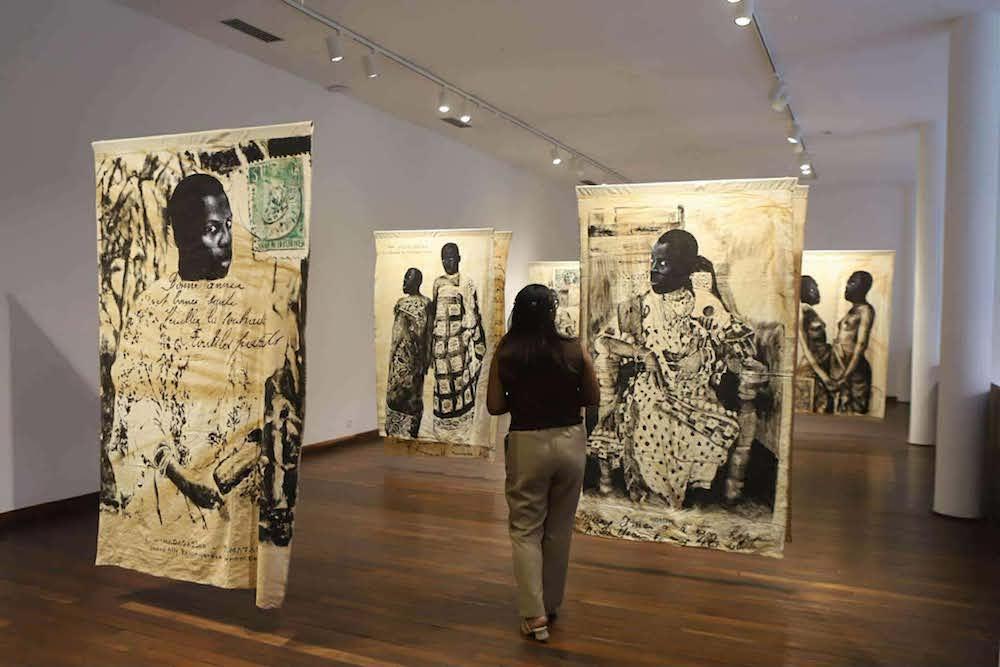
Before welcoming the public, an exhibition goes through a long journey where inspiration, creation, and staging are built step by step.
The public often discovers an exhibition once the works are hung on the walls, without imagining the considerable work that precedes the opening. Behind every painting, sculpture, or installation lies a rigorous creative process involving research, artistic choices, technical preparation, and organization. Several visual artists are lifting the veil on the various steps that transform an idea into an exhibition.
For artist Dina Rabearivelo, everything begins with choosing a strong theme capable of giving unity to the entire body of work. His exhibition ‘Féminin pluriel’ (Plural Feminine) illustrates this approach. ‘The theme is the first step. You have to define everything it will allow you to address,’ he explains. Around the female figure, he develops reflections on education, the environment, women’s rights, and justice, using various techniques such as drawing, acrylic painting, or oil painting on supports ranging from canvas to recycled sheet metal and newspapers.
Once this direction is defined, extensive research begins. Reading, documentation, organizing ideas, and preparing materials sometimes take several weeks. The artist then creates sketches in a notebook, tests different compositions, and selects keywords that will accompany the works before moving to their realization. Once completed, the works receive a layer of varnish to ensure their preservation.
Meticulous preparation
At the same time, he writes his artistic statement, prepares the exhibition catalog, and establishes the labels mentioning the title, dimensions, technique, year of creation, and price of each work. Scenography constitutes the final step before the installation. The works are arranged according to a narrative logic to offer the visitor a coherent journey.
For Jonny Andriamanankoavy, an exhibition also requires meticulous preparation, far beyond mere artistic creation. The artist first chooses his medium—painting, drawing, or sculpture—before defining a theme and then finding an exhibition venue. He then organizes communication by reaching out to the media and sending invitations to journalists, gallery owners, and collectors. ‘None of these steps should be neglected, as the artist’s prestige is at stake in each one,’ he reminds us.
Artist Manantsoa Haga Nisainana describes an equally structured process. ‘An art exhibition begins above all with an inspiration, an emotion, or a desire to create something,’ she emphasizes. This initial impulse then gives way to defining a theme and a message. The works are created or selected, then accompanied by texts, labels, and explanations allowing the public to better understand the artistic approach. After the project is validated by a gallery or cultural space, the production phase begins, which includes logistics, communication materials, transportation of works, and their installation. In parallel, the artist prepares the promotion of the event as well as their public interventions. ‘An exhibition is not just about presenting works; it is also a moment of sharing, dialogue, and meeting around an artistic approach,’ she asserts.
Cassie Ramiandrasoa
Captured & Published at: 2026-07-01 06:42:51 (Madagascar Local Time EAT)
Original Source: https://www.lexpress.mg/2026/07/evenement-les-artistes-devoilent-les.html