
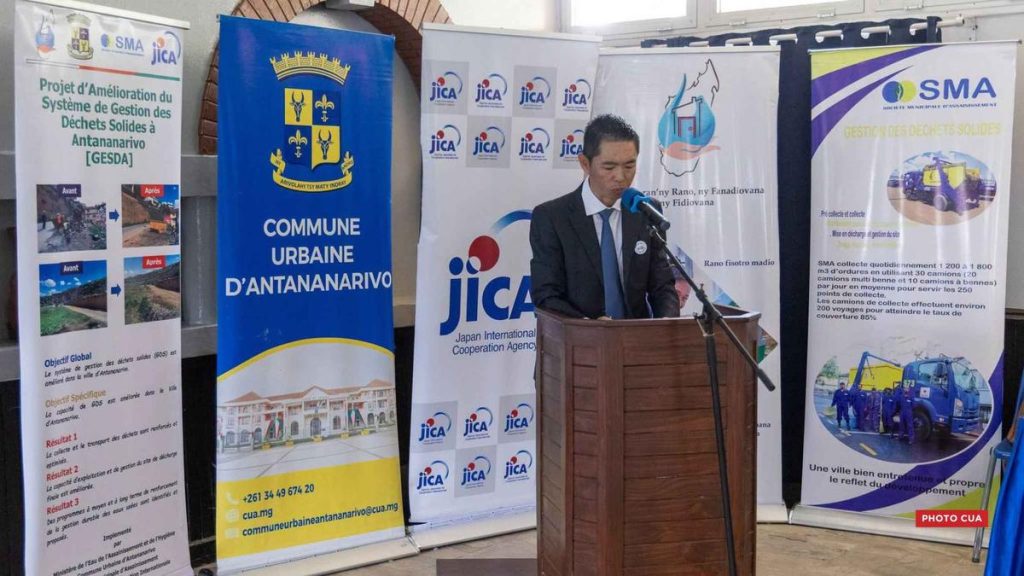
A new habit is taking root. Source-separated waste collection is gradually becoming a reflex for households in Ampefiloha Cité and Ambohitrakely, the two pilot sites for the Antananarivo Solid Waste Management Improvement Project (Gesda). In Ampefiloha Cité, the participation rate has risen from approximately 30% at the start of the experiment to 70–75% currently, according to project results presented on Friday in Anosy.
This progress is accompanied by an improvement in the quality of sorting, project officials report. The system aims to manage waste at the point of production by separating organic waste, known as “fako mora lo,” from non-organic waste, “fako tsy mora lo.” In Ambohitrakely, special attention is also given to plastic bottles that can be recycled.
In Ampefiloha Cité, supporting households is a key lever of this experiment. Sector meetings, practical demonstrations, radio broadcasts, and awareness campaigns have been conducted to encourage the adoption of sorting. RF2 agents, in daily contact with residents, participate in this support. Actions are also carried out in schools to involve students and turn them into ambassadors for their families.
“Sorting begins at the household level. Biodegradable waste can be transformed into compost or fertilizer, while non-biodegradable waste, such as plastics and batteries, requires special handling,” explains Tojoandry Tiana Rafidimanantsoa, Director General of Sanitation at the Ministry of Water.
Waste recovery is also a component of Gesda, which has reached the end of its first phase. Plastic, in particular, can be recycled to produce new materials used in the manufacturing of tiles, brooms, or for certain road works.
For the Japan International Cooperation Agency (Jica), a partner in the project alongside Malagasy institutions, the results obtained are encouraging. “Thanks to three years of collaboration between Japanese experts and the relevant Malagasy institutions, we have significantly improved solid waste management in Antananarivo,” emphasized its representative in Madagascar.
The next step is to extend these practices beyond the two pilot sites. Project officials are planning a gradual expansion of Gesda’s experiments to other fokontany. This momentum could be supported by the Integrated Sanitation Program of Antananarivo (PIAA), which plans to intervene in 48 fokontany in the areas of hygiene and sanitation.
Captured & Published at: 2026-09-06 16:08:34 (Madagascar Local Time EAT)
Original Source: https://www.2424.mg/gestion-des-dechets-le-gesda-rapporte-une-adhesion-des-75-des-menages-dampefiloha-cite-au-tri-a-la-source-des-dechets/