Musicians, visual artists, and event producers must contend with irregular income, high costs, and uncertain profitability. In Madagascar, making a living from culture also requires an economic strategy.
A musician diversifying their performances, a portraitist building customer loyalty, and a producer relying on equipment rental: behind these different paths, a common reality emerges. In the Malagasy cultural sector, passion alone is not enough to guarantee regular income. Between highly variable fees, sometimes rare commissions, and significant expenses to stage a show, professionals must multiply their strategies to live from their craft.
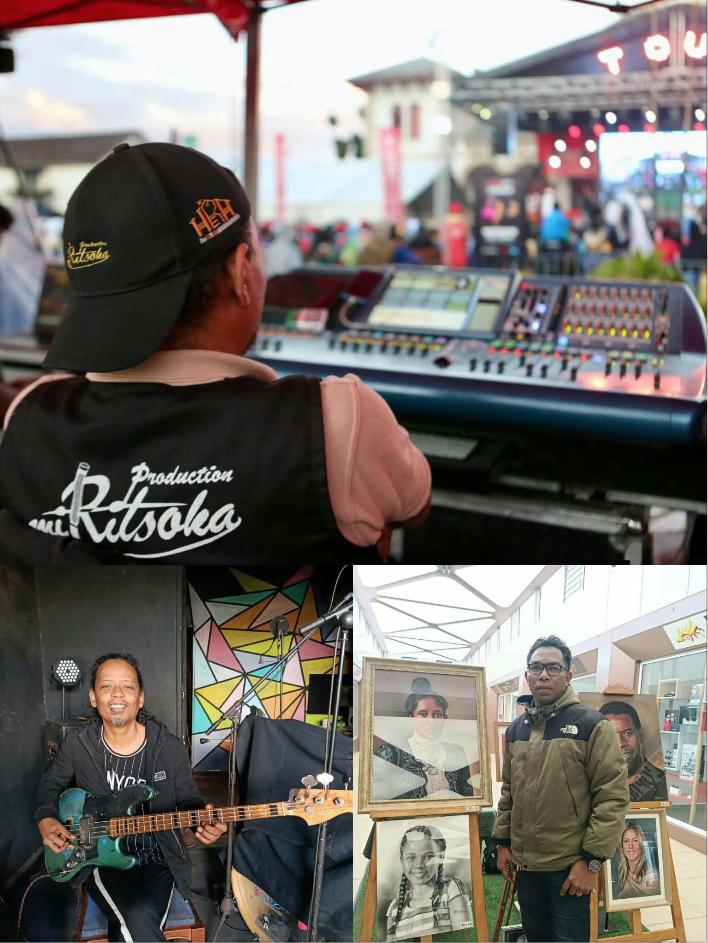
“Before, it was impossible to make a living from music. Today, I fully succeed,” testifies Rolf, a bass player. To make it his profession, he has multiplied his activities, notably by composing advertising music and accompanying other artists. It is a way to diversify his sources of income while remaining faithful to his passion. “I could never do anything else,” he asserts.
However, not all musicians enjoy the same conditions. In a small cabaret, a lesser-known artist can earn between 50,000 and 100,000 ariary, depending on the composition of their group. Conversely, a star can earn several million ariary in one evening. Ball musicians, for their part, may receive fees limited to 30,000 or 60,000 ariary for several hours of performance.
In addition to these disparities are the irregularity of work and the lack of retirement guarantees. A self-taught musician, Rolf learned music on his own before choosing to make it his profession at age 24.
In the visual arts, Andrianjaka Mahery Nirina describes a different path but faces the same imperative: making his talent a viable activity. “You need endurance and, above all, discipline if you want to make it a profession,” emphasizes the portraitist, who draws daily, with or without commissions, to maintain his practice.
Self-taught, he decided in 2008 to live fully from his talent after having worked in another field. His loyal clientele allowed him to transform his passion into a profession, despite prejudices about artists’ ability to earn a living and the difficulties encountered during the Covid-19 pandemic.
His portraits are offered at prices ranging from 240,000 to 9 million ariary, depending on the dimensions of the work and the number of people depicted. His creations range from drawing on paper to painting on canvas or silk, as well as wall frescoes. This diversity allows him to meet different demands.
Economic difficulties do not only concern creators. Event organizers must also deal with significant costs and uncertain revenues. Created in 2008, Miritsoka Production has about 25 employees and has organized some 112 concerts since its inception. To support its activity, the company also offers equipment rental.
Although it has its own logistical equipment, expenses related to concert preparation can reach several million ariary. Advertising, venue rental, and artist fees are major expense items. Profitability then depends on several factors, including the chosen location, capacity, and the fame of the artists.
Miritsoka Production organizes concerts at the Coliseum and the Palais des Sports. However, the choice of pricing must take into account the target audience. Artists who mainly attract a young audience do not necessarily allow for the same pricing as those with a more established reputation.
To promote its events, the company now relies on social media. It also seeks to maintain the quality of its services by following technological developments as much as possible. Despite its eighteen years of activity, the structure does not escape the uncertainties of the sector: according to its representatives, results vary from one event to another.
Diversifying activities, building customer loyalty, controlling expenses, and adapting prices: these three paths illustrate the economic conditions of practicing a cultural profession. However, income remains unequal and depends on orders, engagements, and the public’s ability to pay. Art can provide a living, without guaranteeing financial stability.
Captured & Published at: 2026-10-17 06:24:04 (Madagascar Local Time EAT)
Original Source: https://www.lexpress.mg/2026/10/economie-de-la-culture-vivre-de-lart-un.html