
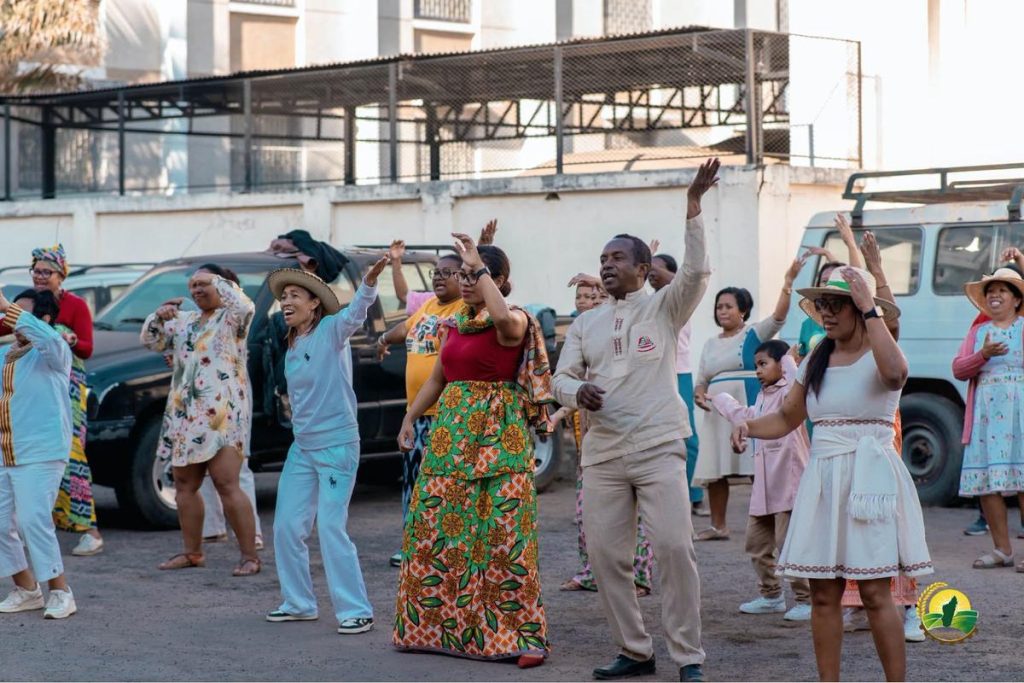
Friday, July 31, marked the launch of the first “Traditional Friday” in the administration. Some state agents complied with the new directive.
The traditional dress code is gradually being implemented in the public administration. Several state agents arrived at their offices wearing traditional attire on Friday, in accordance with the decree adopted by the Council of Ministers on July 17. Men wore the ‘malabary’, a shirt and trousers made of ‘soga’ fabric, a straw hat, and a ‘lamba’; some simply wore a ‘lamba’ over their suits.
Women wore the ‘lambahoany’, a dress made of ‘soga’ fabric or wild silk, accessorized with a hat and/or a silk ‘lamba’. “It feels a bit strange to wear this outfit. People look at you with curiosity. It will surely take time for everyone to get used to it,” said Hery Rakotomanana, a state agent who wore a ‘malabary’, a ‘lamba’, and a hat last Friday. This outfit represented a significant investment for him. “My ‘malabary’ cost 35,000 ariary, the ‘lamba’ 55,000 ariary, and the hat 15,000 ariary,” he added.
Traditional outfits represent a significant cost for many civil servants. Haro Ramiandrisoa had not planned for this expense in her monthly budget. Accustomed to buying low-cost work clothes at thrift stores, she sees this measure as a financial burden. “A simple ‘soga’ dress costs at least 60,000 ariary, a shirt 50,000 ariary, and a men’s set 75,000 ariary. My husband and I are both civil servants, and this unplanned expense weighs heavily on our monthly budget. Plus, we have to buy several outfits because we can’t wear the same ones every Friday,” she explained. Neither she nor her husband owns a traditional outfit yet.
Like this couple, many agents did not wear traditional attire on Friday. “Since there are no precise instructions on wearing traditional attire in our department yet, I didn’t wear one,” another civil servant confided. She plans to have her outfits custom-made by her seamstress.
For sellers of traditional clothing, sales have yet to take off. “The obligation to wear traditional attire has not yet had an impact on us. Customers remain very rare, and we cannot tell if the few buyers are state agents or private individuals,” said Dina Randriamihaja, founder of the company Fitafy Gasy, which specializes in traditional clothing.
The July 17 decree mandates the wearing of traditional attire every Friday. “Whether traditional or modernized, this clothing must reflect the cultural heritage and diversity of the Malagasy regions,” the decree states.
Captured & Published at: 2026-08-03 05:53:59 (Madagascar Local Time EAT)
Original Source: https://www.lexpress.mg/2026/08/fonction-publique-les-tenues.html