Business opportunities related to green and blue value chains were promoted over three days, with operators aiming for new horizons.
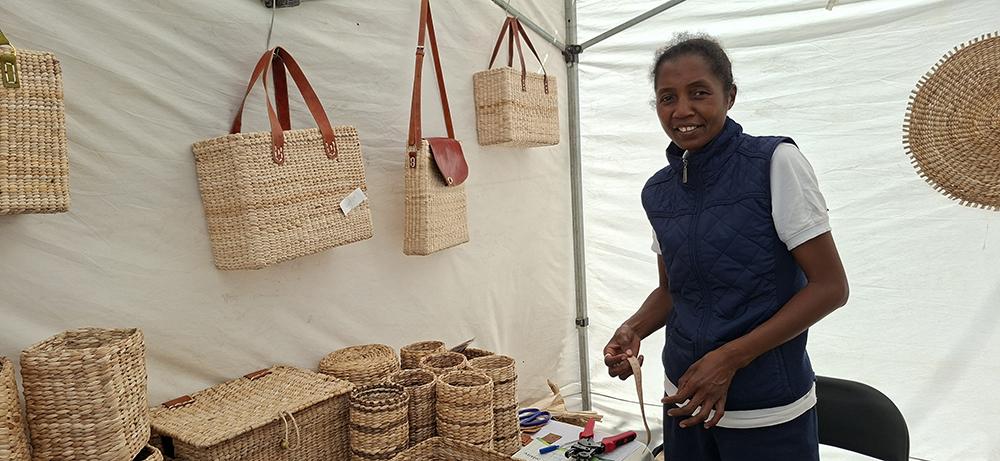
Breaking into the market is the goal for Mbola Voahangy, an artisan specializing in banana fiber processing, who aims to further develop her start-up. “I aspire to new opportunities and new orders, especially from abroad. My start-up has gone through many difficulties, but my business is holding up. It deserves new horizons,” she says.
Through a dozen products made from plant fibers, including interior decoration items, bags, rugs, and poufs, she participated in the green and blue economy fair held on August 14, 15, and 16. The event provided her with the opportunity to forge new partnerships and expand her clientele.
The objective of the event was to promote the green and blue economy of the Atsimo Andrefana region. Food processing companies such as Malakass with its cassava flour, Menatsook with its sea urchin derivatives, and cooperatives of women’s associations involved in landscape restoration or social protection, producing honey or ecological charcoal, were swarmed by visitors. It was noted that the products are now well-packaged and labeled. Gone are the days of bulk products piled in baskets and sold by the “kapoaka” (tin cup). Dried fish and shrimp, in particular, have benefited from better presentation.
Consuming organic and appreciating local products were the key selling points. The public was enthusiastic about the various products and activities related to the green and blue economy presented in the twenty exhibition stands. A series of conferences was organized at the Chamber of Commerce and Industry in parallel with the fair, discussing opportunities in green and blue value chains, available financing and credit, and feedback from operators conducting green and blue activities.
The discussions also highlighted persistent difficulties, particularly regarding market outlets. Many wish to expand their clientele, which remains limited. Panelists and participants also emphasized the demands of customers, who are often confronted with artisans who are still too unprofessional and unreliable.
In this context, vocational training for young people appears to be a priority. The example of “Tulé’art recycling,” which has trained young people in waste processing, is a model to follow. The fair was organized by the Ministry of Environment and Sustainable Development, the Ministry of Agriculture and Food Sovereignty through the Tefiala project, the FAO, the GEF, and local entities such as the Southwest Business Center (Carso), the NGO Tany Ifandovana, and the NGO Saramba Initiative.
“I can only express my satisfaction. This event has once again put Toliara and the Atsimo Andrefana region on a pedestal. We have a lot to make known. We have unique resources,” reacted Lanto Rakotoarivelo of “Art Lanto Design,” a specialist in seagrass fiber crafts.
Captured & Published at: 2026-08-18 05:54:22 (Madagascar Local Time EAT)
Original Source: https://www.lexpress.mg/2026/08/toliara-la-foire-de-leconomie-verte-et.html