
Some historians believe that the first horses were imported to Madagascar on August 6, 1817, with the arrival of those sent by Sir Robert Farquhar, Governor of Mauritius, to King Radama I. These were likely the first seen in Imerina, as correspondence from the Count of Maudave, published in 1886, proves that a small horse-breeding nucleus already existed in Tolagnaro a century earlier.
“A small cavalry troop would make a prodigious impression on the Malagasy. One should hear their cries of surprise and admiration upon seeing our horses. I even have some in the interior. The pastures are very good and these animals are doing wonderfully. I am working to establish a breed of horses here; we already have the seeds; I have nine mares and a beautiful Persian stallion here,” stated the Count of Maudave.
After his departure, no one knows what became of these animals. However, in his work “Horse Breeding in Madagascar” (1907), Captain Sisteron mentions an “old-time fable that led some ancient Malagasy to believe that horses had once existed in the land of the Bara.” But this fable may simply be the memory among the southern populations of the Count of Maudave’s horses. Moreover, the belief in the legendary “songomby” may have its source there.
RP Dubois wrote in his “Monograph of the Betsileo” (1938): “When the Europeans introduced the horse, the Malagasy declared that it was a new species of ‘songomby’. One might therefore wonder if the ancient ‘songomby’ of legends was not simply a wild horse, a stray survivor in the solitudes of some horse from a very ancient and accidental exportation.” But how could they have survived the existing conditions? In his report, Captain Sisteron specifies “that there were no veterinarians on the island; it seems that consultations were requested in writing from veterinarians in Mauritius; one of them, de Beauvais, in frequent contact with Tananarive, served as a broker for Europeans engaged in the horse trade.”
Furthermore, in the capital, two slaves—Bevantanina in the service of the Queen and Ramanana in the service of Prince Ramaniraka—possessed some empirical notions, the secret of which they jealously guarded and for which they charged very high fees. Colic was treated with warm drinks mixed with rum, diarrhea with boiled rice, and to give the coat its luster, horses were put on a diet of cassava roots and sugar cane. At the same time, “The Madagascar News” and “The Madagascar Times,” periodicals of the English Missions, often shared information on breeding and care for common diseases. “From that time until 1895, thanks to several introductions of horses, a ‘Malagasy breed’ was formed, not very well maintained but which could be improved.”
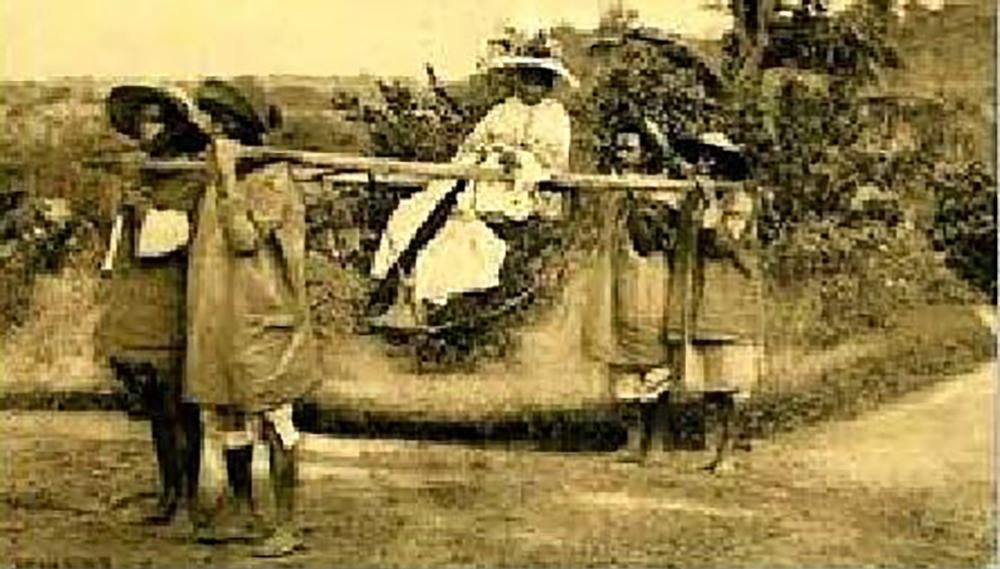
In March 1894, the expeditionary corps formed in France included fourteen military veterinarians, several of whom remained with the occupation corps. General Gallieni began by focusing on improving the horse breed, because as there were few roads, people traveled by Filanjana, which required a large number of porters. However, he intended to use this corporation of strong men for other tasks, which necessitated an increase in horse breeding.
This “horse policy” was marked by the creation of a veterinary service for studs and breeding in 1903. But as early as 1896, a first stallion depot was installed in Fiadanana, replaced a year later by the Ampasika stud farm, which supplied mobile depots during the breeding season in Antsirabe, Ambositra, and Arivonimamo. A little later, the model farm of Iboaka was created near Fianarantsoa, followed by the stud farm established in Toamasina, then another in Androy to serve the various points of the colony.
Veterinary districts were organized in parallel and public slaughterhouses were built, while common consumption meats (beef, pork, etc.) were inspected. For while the Malagasy profess a true cult for the zebu, they were entirely defenseless against diseases.
Captured & Published at: 2026-10-02 05:40:48 (Madagascar Local Time EAT)
Original Source: https://www.lexpress.mg/2026/10/le-cheval-apparait-dans-le-sud-en-1786.html