
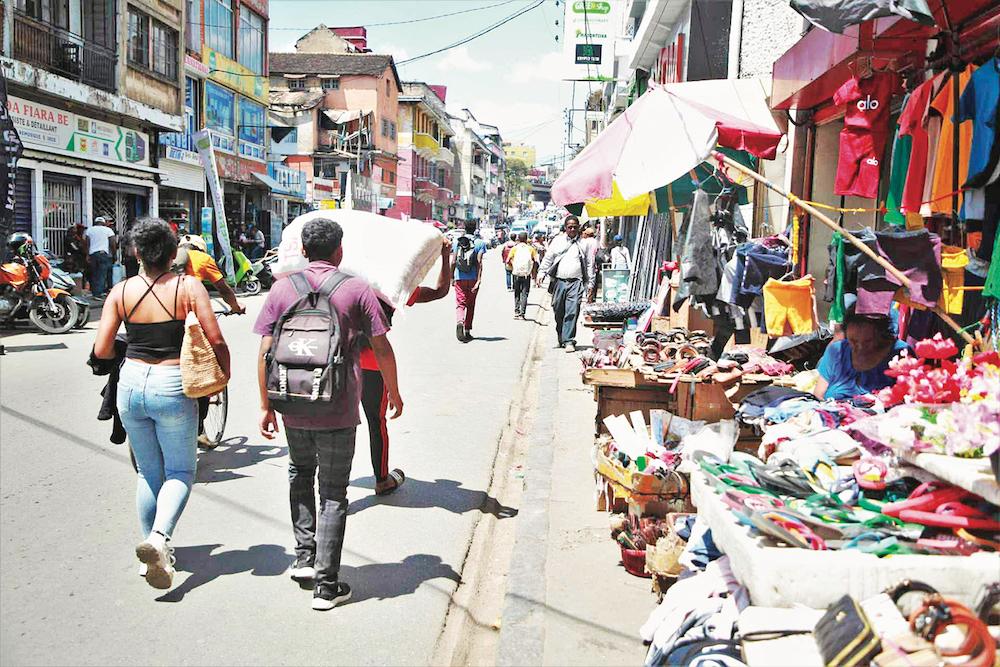
From Analakely to Ampasampito, vendors, cars, and buses are competing for road space in Antananarivo. Due to the lack of usable sidewalks, an increasing number of pedestrians are forced to walk on the roadway.
In Antananarivo, public space is increasingly encroached upon by merchants, vehicles, and public transport. In several districts of the capital, this situation reduces the space reserved for pedestrians and complicates daily commutes. From Analakely to Ampasampito, passing through Ambanidia and Behoririka, sharing the road remains a challenge.
In Analakely, sidewalks are largely occupied by vendors. Even when some reduce their footprint, their presence continues to limit pedestrian passage. In the busiest areas, passersby must sometimes weave their way between stalls and other road users.
The situation is also visible in Ampasampito. On some axes, the sidewalk is so occupied by commercial activities that part of the roadway has been repurposed with barriers to create a passage for pedestrians. The sidewalk, which should normally ensure their movement, has become a commercial space, while the roadway now accommodates foot traffic.
This occupation is not new. Tiana, after speaking with merchants, testifies: “Some vendors have been here for a very long time. Making them leave could be difficult.” This reality illustrates the complexity of managing public space, where commercial activities are also a source of income for many families.
In Ambanidia and Behoririka, the situation is even more pronounced. Some places practically no longer have a clearly identifiable sidewalk. Different uses of the public road overlap, including car traffic, commerce, parking, and pedestrian movement.
However, this pressure does not only concern vendors. Parking is also a factor in reducing available space. Vehicles parked near sidewalks or on certain sections of the road further limit pedestrian circulation possibilities.
Public transport also contributes to this occupation of space. According to the CUA Communication Department, about 1,200 bus stops are recorded in the metropolitan area. On the ground, however, some spaces seem insufficient to accommodate buses and passengers. Vehicles may wait in the background before picking up passengers, adding further occupation of the roadway.
General traffic exacerbates this pressure. According to the CUA, traffic is estimated at between 100,000 and 250,000 vehicles per day, while some roads are designed for a maximum of about 50,000 vehicles. This concentration of uses turns some axes into real tension points.
Behoririka, Soarano, Andrahavoangy, Ankorondrano, Ampasampito, the Akadimbahoaka roundabout, 67 Ha, Vatobe, Ampasika, and Itaosy are among the sectors where difficulties are noted.
Behind this battle for public space lies a very concrete question for residents: where to walk when the sidewalk is no longer available? For workers, students, the elderly, or people with reduced mobility, walking on the road can become a necessity rather than a choice.
Managing this shared space is a daily challenge for the capital. The organization of commerce, parking, bus stops, and traffic must reconcile economic needs with the movement of residents, so that public space remains accessible to all.
Captured & Published at: 2026-09-30 00:23:35 (Madagascar Local Time EAT)
Original Source: https://www.lexpress.mg/2026/09/antananarivo-les-pietons-perdent-leurs.html