
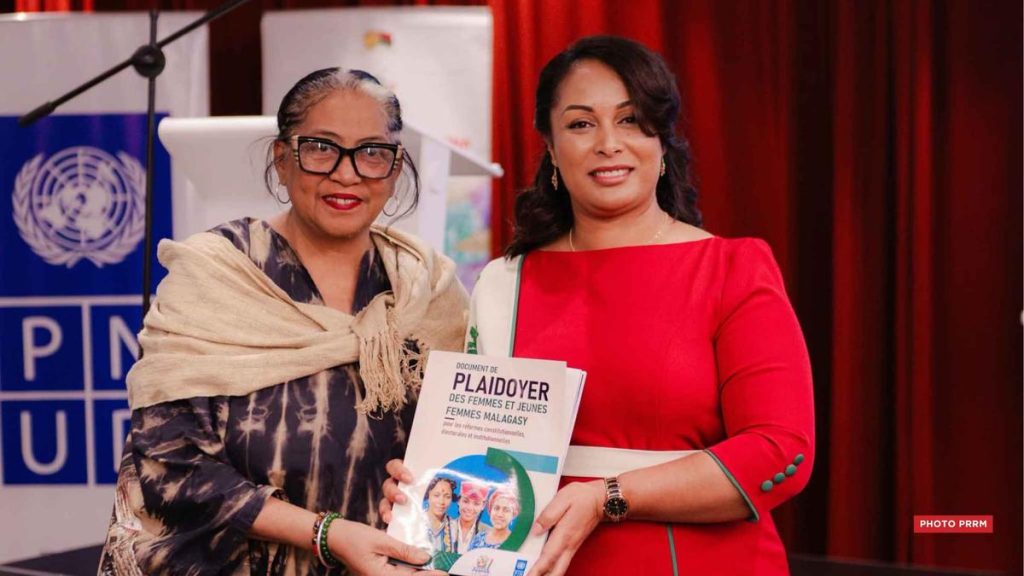
Quotas for elective and appointive positions, candidate lists alternating between women and men, a reduction in electoral deposits, and an independent mechanism to monitor gender parity. Malagasy women and young women are calling for the adoption of legal and constitutional measures to facilitate their access to political responsibilities and decision-making roles. These proposals were presented on Friday during a feedback meeting attended by First Lady Elisa Randrianirina and Japanese Ambassador Tojima Hitoshi.
The document calls for evolving the institutional and electoral framework to allow for greater participation of women and young women in public life and decision-making processes as part of the country’s refoundation. It compiles recommendations from the National Forum of Malagasy Women and Young Women Leaders, held on June 4-5 in Antananarivo. Supported by the United Nations Development Programme (UNDP) through its Elections project, with backing from the Japanese government and other partners, the advocacy document includes 17 proposals divided into three reform axes.
The first axis concerns constitutional and legal reforms. Participants propose enshrining gender equality as a fundamental principle of the Republic and establishing a threshold of at least 40% for women in elective and appointive positions. The document also recommends strengthening protection against gender-based violence, particularly during electoral periods.
The second axis focuses on the accessibility and equity of the electoral process. Women and young women propose the introduction of “zippered” candidate lists, alternating between female and male candidates. They also request that at least 30% of spots be reserved for youth, with half of those allocated to young women.
The issue of the cost of electoral participation is also raised. The document advocates for lowering the deposits required for candidacies, which are seen as a barrier to the political engagement of women and youth. During the presentation, a young female leader cited the 2023 presidential election, in which no women were candidates, noting that the 200 million ariary deposit was a significant factor.
The third axis aims to make institutions more representative and inclusive. The advocacy calls for the generalization of parity in high-level civil service appointments. It also proposes gender-sensitive budgeting and the creation of an independent national mechanism to monitor the implementation of parity in public institutions.
The stated goal is to move from essentially consultative participation to an effective presence of women and young women in spaces where decisions concerning the country’s future are made. For the Minister of Population and Solidarity, Cathia Voahanginirina Rakotoniaina, the challenge goes beyond equal rights and touches on “a deep involvement in the very foundations of the refoundation.”
UNDP Chief Technical Advisor François Butedi describes the document as “a kind of barometer” and a reference point to support monitoring, dialogue, and mobilization around these commitments. “Women’s participation is not a privilege, but a matter of utility and right,” he emphasized.
First Lady Elisa Randrianirina called for translating these recommendations into concrete measures. “This document must inform future national consultations and inspire the drafting of new legislation,” she declared. She also advocated for monitoring the implementation of the recommendations and for accountability to citizens.
Captured & Published at: 2026-09-19 09:38:34 (Madagascar Local Time EAT)
Original Source: https://www.2424.mg/refondation-les-femmes-et-les-jeunes-femmes-plaident-pour-des-reformes-legales-favorisant-leur-acces-aux-postes-electifs-et-de-decision/