
From contemporary themes to acrobatic figures, the hira gasy adapts to its era while preserving the codes that have made it unique for generations.
Discussing mobile phones, current social realities, or the daily concerns of the Malagasy people, all while wearing costumes inherited from the royal era: this contrast summarizes the trajectory of the hira gasy. Rooted in Madagascar’s history, this popular art form continues to evolve without renouncing its foundations, allowing hundreds of artists to keep a tradition alive across generations.
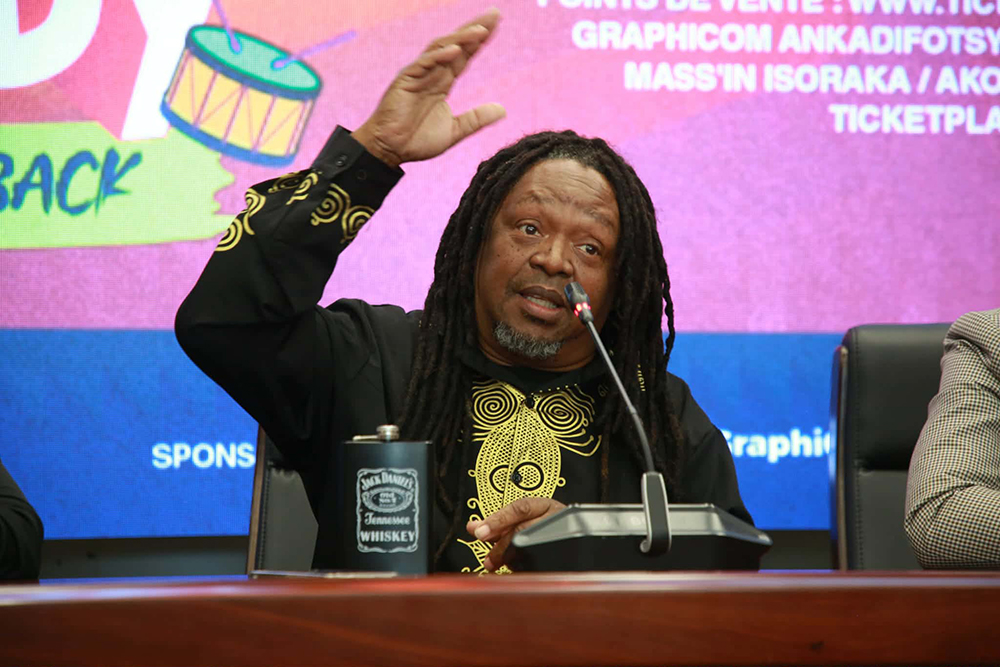
‘The hira gasy follows the evolution of society,’ summarizes Rossy. Although he is not a mpihira gasy (hira gasy performer) himself, the artist grew up with the famous Ramilison troupe. Today, he works with many descendants of the great hira gasy families within his own group. ‘We select the best elements from these troupes,’ he explains, highlighting the artistic richness of these performers who are capable of singing, playing instruments, and dancing simultaneously.
This adaptability is first seen in the themes addressed. While traditional values remain at the heart of the performances, artists no longer hesitate to evoke the changes in contemporary society. The songs address everything from respect for parents, truth, and solidarity to modern behaviors and new lifestyle habits.
For Razafimahatratra Mamitiana Radomanana, secretary-general of hira gasy artists in Madagascar and a songwriter since 2010, this evolution is a necessity. ‘Inspiration comes from what we observe in real life,’ he explains. The lives of farmers, daily situations, and social changes nourish his creations. With pen and notebook in hand, he notes his ideas during his travels before transforming them into songs for the stage.
Despite this modernization of subjects, the structure of the hira gasy remains intact. Each performance maintains its traditional flow. Artists enter the stage to applause, follow with the ‘kabary’ (traditional speech) to introduce the main theme, and then develop their reflections through the ‘renihira’ and ‘zanakira’. The performance concludes with various choreographic sequences, notably the ‘dada’ and ‘dindahy’.
This transmission concerns more than just songs and texts. The mpihira gasy are also distinguished by their artistic versatility. ‘They are all multi-instrumentalists,’ stresses Rossy. In addition to singing, they master several traditional instruments and participate in every component of the show. For many, this training begins in childhood within their families. According to Razafimahatratra Mamitiana Radomanana, many artists come from lineages of mpihira gasy where know-how is passed down from generation to generation. Talent, cultivated through contact with elders, is paired with practical training that allows the youngest to perpetuate an artistic heritage that is sometimes centuries old. Thus, the descendants of the great troupes continue to keep this art alive while preparing the next generation.
The spirit of intellectual confrontation remains a major characteristic of the genre. Two troupes respond to each other on the same theme in a format reminiscent of a philosophical debate. Each defends its vision of the subject through lyrics and tries to convince the public of the relevance of its argument.
Evolution also affects stage performances. Alongside traditional movements like the ‘latsitanana’, ‘dihy soroka’, ‘dada’, or ‘dindahy’, more modern and sometimes acrobatic figures have been added. Yet, historical symbols remain omnipresent. The famous red costumes continue to set the artists apart.
Captured & Published at: 2026-06-20 06:30:03 (Madagascar Local Time EAT)
Original Source: https://www.lexpress.mg/2026/06/chant-traditionnel-le-hira-gasy-evolue.html