
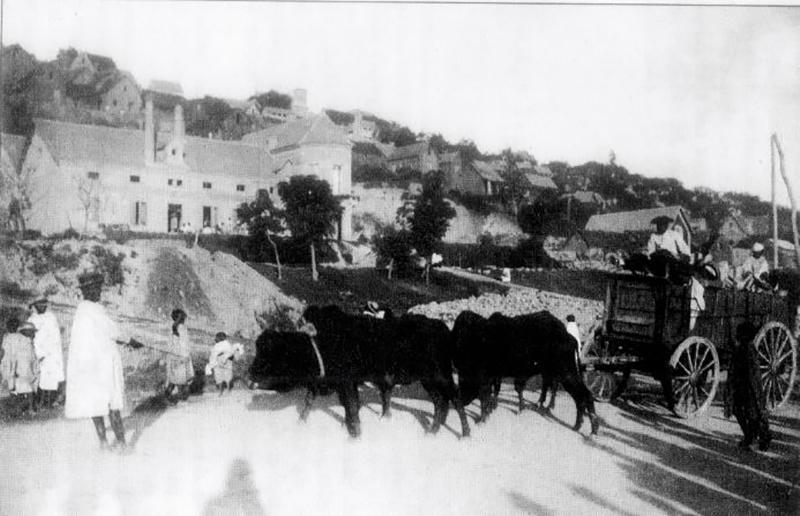
At the beginning of the 20th century, countless colonial dramas unfolded on the island, some involving bloodshed and others lacking excessive violence. Yvan-G. Paillard recounts one of the latter under the title ‘The Misadventures of a Sunday Settler’. The scene is set approximately 15 kilometers west of Antananarivo, in Ampangabe, within the district of Ambohidratrimo, very close to Ambohitrimanjaka. The main character is the settler Charles-Auguste Couesnon.
He arrived from France at the age of 29 in 1898. ‘He was an educated man, a bachelor of science. The son of a farmer, he himself had some experience with the land.’ Rather than staying in the administration, where he spent a short time, he decided to make his fortune in cultivation and livestock, settling on the south bank of the Sisaony, where the river merges definitively with the Ikopa.
The region is partly floodable and marshy, but suitable for development into pastures and rice fields under the protection of dikes. Couesnon was not the only settler in the region; several Europeans were already there, including Jules Louveau, a lawyer from Antananarivo who came to develop several hundred hectares. In March and July 1906, Couesnon obtained 30.63 hectares in four parcels under the heading ‘La Brie’, for which he paid only for the 11.77 hectares of the provisional title, with the rest granted to natives.
Charles-Auguste Couesnon certainly worked very hard in his early days. He soon took a young Malagasy woman as his wife, who would bear him two children. He initially lived in a rudimentary manner in the village of Ampangabe. ‘He was seen leading the plow himself, avoiding hiring too much labor, which was ultimately expensive and often reluctant.’ He experimented with new cultivation methods. Various editions of the Guide-Annuaire in 1901 presented Couesnon and Louveau launching into the cultivation of potatoes, buckwheat, and especially artificial pastures for intensive livestock farming.
But according to Yvan Paillard, ‘the illusions of the early days of occupation soon vanished.’ First, the initial potato harvest was destroyed by an invasion of caterpillars. Then, all businesses focused on the market suffered heavily from the severe commercial slump at the very beginning of the 20th century. It finally appeared ‘that the Malagasy land was ungrateful to the European,’ particularly on the High Plateaus.
However, Couesnon persevered and multiplied his experiments. In 1903-1904, he distinguished himself among the breeders of the province. Having some local mares, he tried to cross them with stallions imported and provided by the Colony. ‘The latter indeed encouraged this breeding, which would perfectly solve the priority problem of transport.’ He also raised mules, sheep, and, naturally, cattle—both draft oxen and dairy cows. He even tried to produce cheese, ‘Brie-style, naturally.’ Faced with his difficulties and tenacity, the administration showed benevolence and recommended him for various decorations.
Gallieni closely followed his efforts, and Couesnon knew how to show ‘how difficult and painful the situation of an independent settler is.’ Augagneur would say ‘it is shameful…’ when observing the settler’s difficulties. In 1906, the latter was able to use penal labor (twenty common law prisoners) and in 1907, during the harvests, forty prisoners and fifty men from Manjakandriana. It thus seems that the authorities helped him find workers. ‘The fact proves in any case that Couesnon had some difficulty recruiting labor in Ambodirano and Marovatana, which are not, however, deserted regions.’
Irritated by this situation and encouraged by the ‘benevolence of the administration,’ rather than receiving from it in 1906 and 1907 ‘the dubious help of common law prisoners,’ he would have liked it ‘if it had somehow obliged the neighboring villagers to come and work for him, since under the guise of the fokonolona statute labor, a large number of natives who did not own rice fields participated in the annual maintenance work of the dikes. It would therefore not be more unjust to decide to have them harvest the rice for a wage,’ he wrote to Augagneur on April 25, 1906.
In 1907, he further requested ‘twenty-five natives’ who could work for him four to five days a week for a month. ‘Of course, it would only be individuals who had not yet paid their overdue taxes, sanctioned under the indigenous regime.’ But the suggestion ’emanated like a whiff of the Fanjakana service system officially abolished on January 1, 1901,’ and Yvan Paillard concludes: ‘These difficulties already let us guess what the real relations of the settler with his Malagasy neighbors were!’
Captured & Published at: 2026-06-30 17:11:42 (Madagascar Local Time EAT)
Original Source: https://www.lexpress.mg/2026/06/ladministration-aide-un-colon-non.html