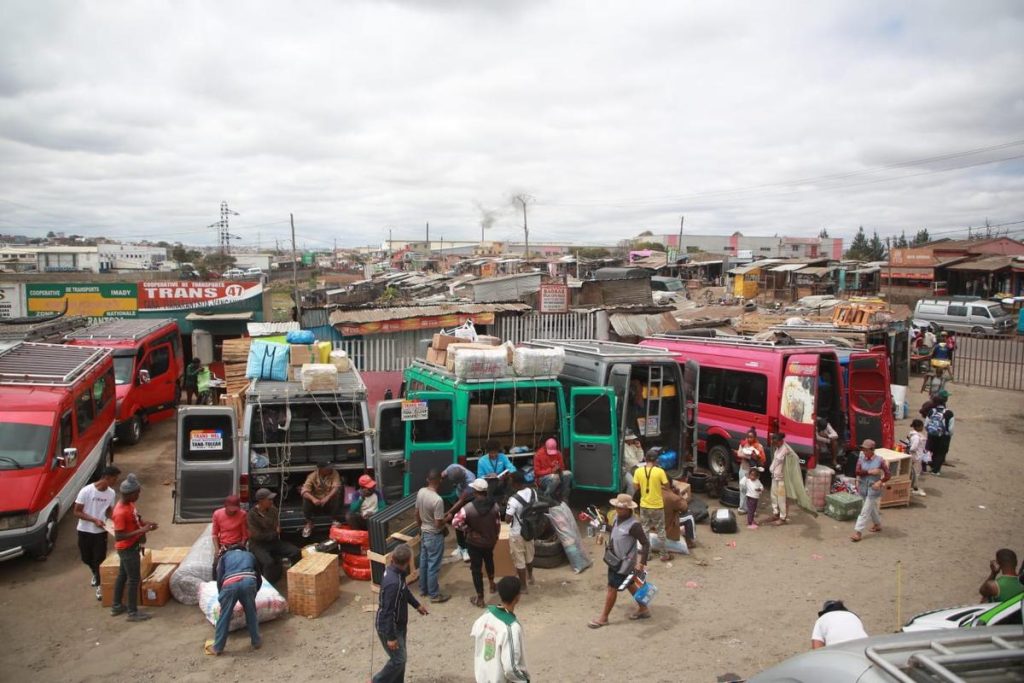
In Fasan’ny Karana, economic activity goes far beyond passenger transport. A whole economic microcosm has developed there, and its participants now share the same anxiety about the future.
The site owes its name to the place where the Indian community—’karana’ in Malagasy—cremates its dead. Located in the Andrefan’Ankadimbahoaka district (4th arrondissement of the capital), between Soanierana and Anosizato, this road hub has become, over the years, the nerve center of national transport.
However, life at the site extends well beyond bus journeys. Merchants, porters, parking managers, grocers, and bicycle taxi drivers earn their daily living there. The plan to relocate the bus station to Amoronakona is causing deep anxiety among these workers.
Michel Rakotomandimby has been selling bags there for nearly a decade. “I have been working here for eight years. I don’t know where we will be able to set up in Amoronakona. Yet, this activity is what allows me to feed my family,” he confides.
Jeanne, a seller of chargers and various items, estimates that several hundred merchants operate on-site. A strong sense of solidarity has developed among them: “When a traveler is destitute and needs to return home, we pool our money to pay for their return ticket,” she says. However, she is worried about the conditions at the new site, fearing that the available space will not easily accommodate everyone.
A few meters away, porters wait for customers to carry their luggage, earning about 15,000 ariary per day. For these young people, this informal work is a crucial source of income. “If we are asked to leave, where will we go? We don’t have degrees to apply for jobs elsewhere,” one of them says.
Parking managers share the same uncertainty. Livasoa Rakotoarisoa, who manages a motorcycle parking lot, summarizes the situation: “What we earn is modest, but it is our livelihood. We do our best to provide for our families.”
Bicycle taxi drivers also depend directly on the flow of users. “Our clientele is mainly composed of travelers. We transport people or parcels,” explains Sendra. During holiday periods, he can take between 20 and 30 clients per day, compared to about ten in the low season. “It is our only source of income,” he specifies.
Groceries, stalls, porters, parking lots, and two-wheelers form an economic fabric inseparable from Fasan’ny Karana. The relocation of the station will not only change the habits of users; it is set to disrupt the lives of hundreds of families who depend daily on its bustle.
Captured & Published at: 2026-09-12 05:53:59 (Madagascar Local Time EAT)
Original Source: https://www.lexpress.mg/2026/09/fasanny-karana-langoisse-des-petits.html