
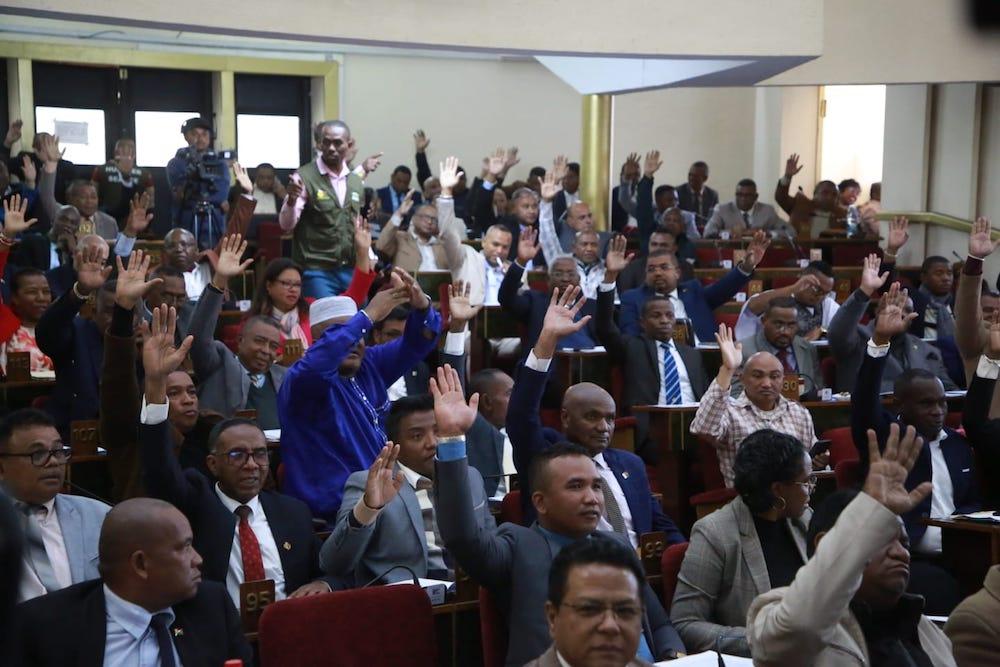
Deputies have adopted the law creating the Economic, Social, and Cultural Council (CESC). It aims to strengthen dialogue between public authorities and the nation’s vital forces.
Termed a “fundamental organic law” by the National Assembly, this long-awaited body is finally entering its implementation phase. Amidst lively debates yesterday in Tsimbazaza, deputies adopted the organic law for the establishment of the Economic, Social, and Cultural Council (CESC).
After fifteen years of anticipation, this constitutional body, provided for by Article 105 of the 2010 Constitution, is finally becoming operational and is presented as a new space for dialogue between public authorities and the nation’s vital forces. The session was held in the presence of government members and youth representatives.
The current configuration of the body accounts for the political and institutional context. The members’ mandate is set at three years, renewable once, pending a potential constitutional revision.
“CESC members will participate in this transitional phase before the adoption of a new Constitution, which will then allow for the establishment of a five-year mandate,” explains Clarisse Manjary, deputy elected for Ivohibe and member of the commission in charge of the project.
The CESC will bring together 111 members from different regions of the country, representing civil society organizations, trade unions, entrepreneurs, artisans, as well as Gen Z and Gen Y youth, notably integrated following the demonstrations of September and October 2025.
A space for participation
Beyond its institutional establishment, the CESC is primarily presented as a tool intended to strengthen citizen participation in the management of public affairs. The goal is to open public life to citizens who do not wish to engage in political parties. “It was necessary to create a framework allowing vital forces to contribute to the country’s development without going through partisan life,” emphasizes Deputy Hervé Hagnonona, elected for Betioky Atsimo (who sponsored this bill before the National Assembly), recalling the body’s strictly consultative role, without legislative power or government oversight functions.
From a historical perspective, Thierry Radafindranaro, deputy for Antananarivo Avaradrano, believes this establishment responds to a necessity that emerged after successive political crises. “The various crises Madagascar has experienced have shown the importance of a permanent space for dialogue between leaders and the nation’s vital forces,” he explained, recalling the reflections stemming from the 2009 crisis.
Following the adoption of the text, parliamentarians see it as a step toward “a more inclusive democracy.” From now on, all components of society will be able, through this consultative framework, to formulate proposals and participate indirectly in national governance.
Captured & Published at: 2026-07-03 06:13:04 (Madagascar Local Time EAT)
Original Source: https://www.lexpress.mg/2026/07/assemblee-nationale-les-deputes-mettent.html