
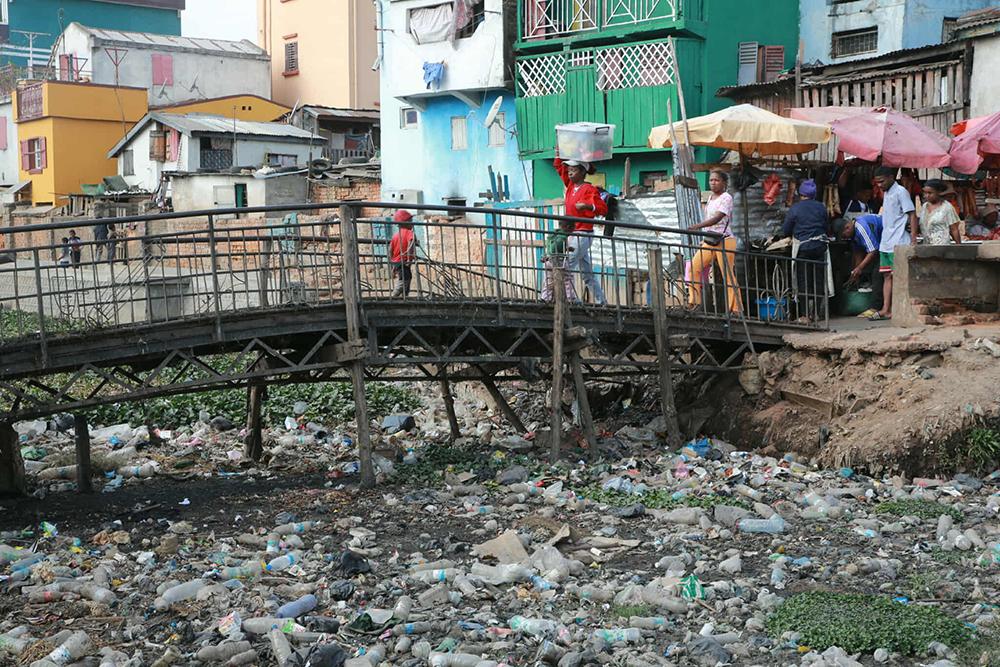
The city is breathing a little easier as mountains of trash have become less visible. “A slight improvement in waste collection has been observed. There is no real piling up of garbage at the moment, whether in the market bins or in our neighborhood,” testified Gabriel Rakotomalala, president of the Anosibe traders’ association, a district where mountains of trash frequently formed in the past.
Most of the trash bins in the 192 fokontany are in a similar state, with trucks passing by regularly. The Municipal Sanitation Company (SMA), responsible for collecting waste and cleaning small canals, claims a collection rate now reaching 80 to 85%.
However, the bins are not completely emptied. In areas far from main roads, waste continues to accumulate. Residents fear the situation will worsen with the arrival of the rainy season, which coincides with the fruit season, leading to an increase in waste. The SMA currently collects nearly 1,300 tons of waste per day, a volume that could rise to over 2,000 tons during the rainy season.
Sanitation remains an eternal problem for Antananarivo. The Household Waste Fee (ROM), levied on the Property Tax on Built Properties (IFPB), and the wastewater sanitation fee, collected via Jirama bills, are the main funding sources. However, the collection rate for these taxes remains extremely low.
For the 2021 and 2022 fiscal years, only 15% of taxpayers paid their taxes, representing 33,000 out of 200,000 homes. For the 2023-2024 period, during the August-September 2026 campaign, only 20 to 25% of the 28,000 homeowners who received a tax notice paid. The municipality plans to send out another 200,000 to 300,000 tax notices.
A large portion of the population refuses to pay. “We paid the IFPB before, but we no longer do so because we see no development in return for our money,” says Denis Raherimalala, an Antananarivo resident. The Urban Commune reminds citizens that no development is possible without resources. Currently, non-payment of the IFPB carries no direct sanctions.
This low collection rate directly impacts city sanitation. Of the 40 trucks owned by the SMA, only 23 to 25 are operational daily. The funds collected are insufficient to maintain the fleet, as the SMA requires about 2,000 liters of fuel per day, excluding maintenance costs.
Captured & Published at: 2026-09-17 06:24:10 (Madagascar Local Time EAT)
Original Source: https://www.lexpress.mg/2026/09/antananarivo-les-problemes.html