
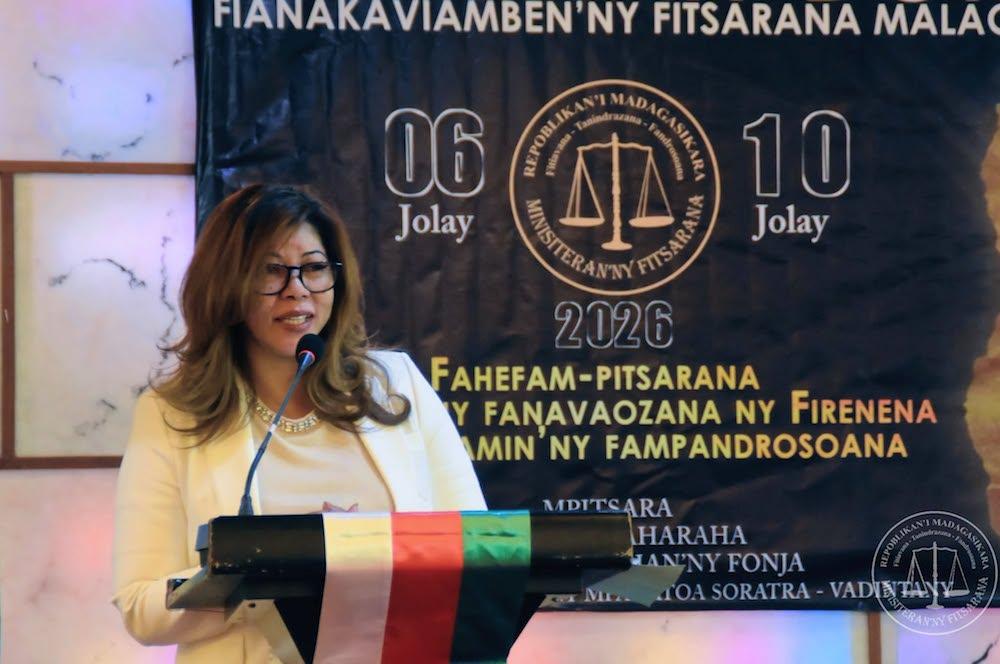
Following other sectors, the Judiciary has been holding national assizes in Ivato since yesterday. The goal is to strengthen its independence and efficiency, while also regaining the trust of citizens.
A titanic undertaking. These are the words used by Andrianaina Rabarisoa, President of the Council of State, to measure the scale of the challenge facing the Judiciary, which has been holding national assizes in Ivato since yesterday.
The national assizes of the Judiciary will run until Friday, with the central theme: “Judicial power as a guarantor of the Refoundation for the country’s development.” Six hundred actors of the judicial system are expected to participate to discuss six specific themes. “These assizes aim to rebuild the judicial system and develop a strategy to show the population that the Justice system is there to defend them,” declared Fanirisoa Ernaivo, Minister of Justice, in her opening speech.
The fair and impartial application of the law, the effectiveness of the principle of equality before the law, and the reconquest of citizens’ trust are among the goals stated by the Minister. “It is based on the decisions of these assizes that we will build an impartial, independent Judiciary with sufficient means to work independently,” she added.
The terms of reference for the Ivato assizes indicate that this exercise reflects a desire “to build a justice system that is more independent, more efficient, more transparent, and closer to citizens.” In essence, the ongoing discussions should lead to resolutions intended to restore the Judiciary to the fullness of its mission, which consists not only of sanctioning, but also of defending citizens’ rights and arbitrating conflicts within society.
Minister Ernaivo cited the example of land disputes and the issue of the burden of proof in court, which are points difficult for litigants to understand. These misunderstandings lead them to debate or even challenge judicial decisions. Such misunderstandings must therefore be clarified.
Demystifying Justice
The five-day program includes commission work on specific themes, ranging from evaluating the current functioning of the judicial system to developing a national roadmap for justice sector reform. Identifying challenges faced by sector actors and proposing institutional and organizational reforms adapted to national realities are also on the agenda.
One commission will focus on the appropriate strategy to strengthen the independence, efficiency, and credibility of the Judiciary. There will also be working sessions on improving prison administration governance. The fight against corruption is also on the list of challenges, alongside efficiency. In her speech, the Minister emphasized an important parameter for a true refoundation of the Judiciary: “a change in mentality and behavior.”
Fanirisoa Ernaivo stated, “It is not enough to change the system or the structure. We must now rethink the principle of Truth upon which Justice is based, that of equality for all before the law and the application of the law in a fair and impartial manner.” This view was supported by the President of the Council of State, who responded to the Minister’s speech.
“I fully share the analysis of the Minister of Justice: no lasting transformation of our judicial system will be possible without a change in mentality, starting with that of the justice actors themselves,” maintained Judge Rabarisoa. He added that “magistrates, in particular, must fully realize that the Malagasy Justice system has been freed from any form of capture. It is now up to us to do everything possible to straighten it out and restore the fullness of its mission.”
Captured & Published at: 2026-07-07 06:12:51 (Madagascar Local Time EAT)
Original Source: https://www.lexpress.mg/2026/07/concertation-la-justice-lheure-de-la.html