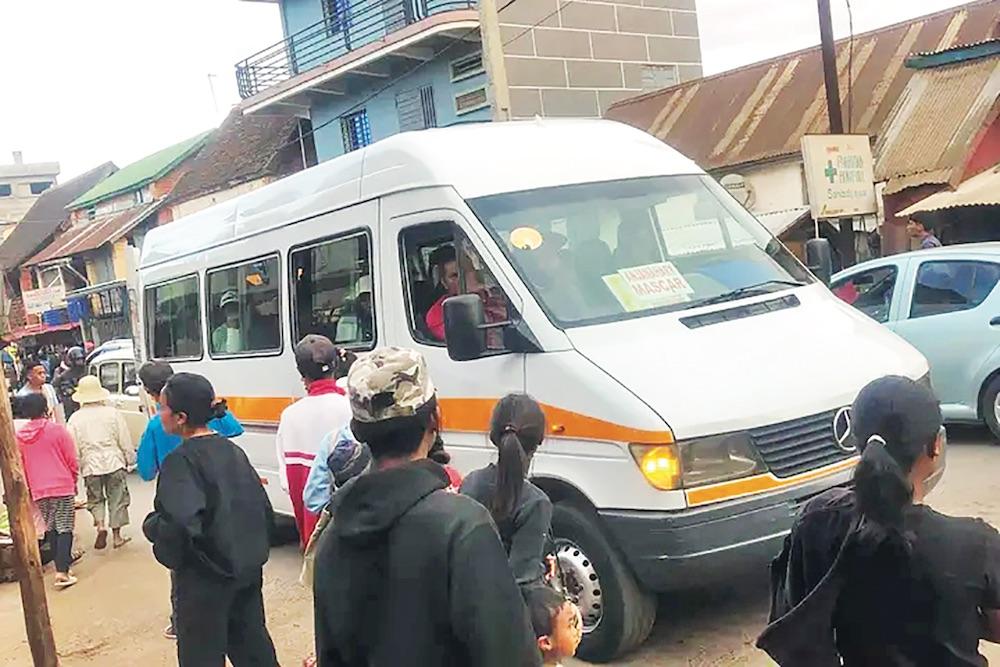
For thousands of commuters in Antananarivo, the ‘taxi-be’ (public minibus) is an unavoidable daily expense. Depending on the number of vehicles used, the distance traveled, and traffic conditions, transport can represent a significant portion of a monthly budget.
For Tina, a salaried employee, the calculation begins every morning. She commutes daily between Alakamisy Fenoarivo and Ankorondrano, taking two taxi-bes each way. With fares of 600 and 800 ariary per leg, her daily transport cost is 2,800 ariary. Over 26 working days, this amounts to 72,800 ariary per month, or 16.2% of her 450,000 ariary salary.
The burden is not just the ticket price, but the cumulative effect of multiple transfers. Other commuters, like Bebilalaina, sometimes walk long distances to save money, while the issue of ‘tapa-dalana’ (partial routes) often forces passengers to pay multiple times to reach their destination.
On the operators’ side, the costs are equally high. A taxi-be operator on Line E reports daily fuel costs of 160,000 ariary and a 90,000 ariary payment to the vehicle owner, totaling 250,000 ariary before accounting for crew wages and maintenance. Some operators also face significant loan repayments for their vehicles.
Ultimately, the taxi-be remains the central axis of daily life in the capital. While both passengers and operators face economic pressures, any fare adjustment remains strictly regulated by the Urban Commune of Antananarivo (CUA) and the Land Transport Agency (ATT).
Captured & Published at: 2026-10-07 05:53:34 (Madagascar Local Time EAT)
Original Source: https://www.lexpress.mg/2026/10/transport-urbain-le-taxi-be-dans-le.html