
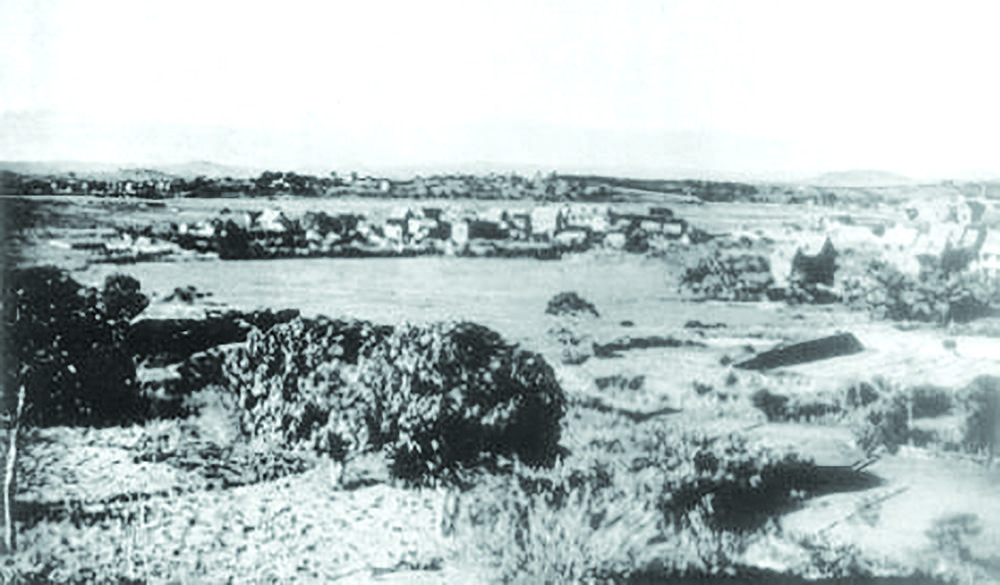
During the plague epidemic of July 1921, ‘natives and Asians without exception were prohibited from leaving the capital, while Europeans obtained authorization to travel after ten days of observation,’ notes Faranirina V. Esoavelomandroso in a study titled ‘From plague as a disease to plague as politics: Interpretation by the Merina of the endemic plague phenomenon in the Central Highlands (1921-1936).’
According to the researcher, the pressure from Antananarivo merchants was more decisive than hygiene considerations in shaping travel controls during the epidemic. She notes that such an observation could not escape the indigenous elite, who were aware of the efforts made by the Chamber of Commerce, specifically its president, Guinaudeau. ‘Information threatened to spread rapidly among a population on high alert and create unrest in the city.’
Once the sanitary cordon was lifted in August 1921, Europeans could move freely, while Malagasy people were required to carry a sanitary passport issued upon presentation of an anti-plague vaccination certificate. ‘For the natives, this passport could have the same meaning as the ‘card’ attesting to tax payments or the ‘individual booklet’ certifying employment.’ In short, it was an additional paper allowing the administration to track ‘irregulars’ and ‘vagabonds.’ This control persisted in the years following 1921, and Malagasy people wishing to travel, especially those wanting to take a train, were subjected to a series of administrative hassles.
They had to accept the vaccination that the Malagasy people dreaded so much; yet for Dr. Thiroux, it was ‘the simple, effective means of pressure to impose’ this immunization. However, to evade this control, the Malagasy resorted to various subterfuges made possible by the contradictions of the colonial system. At the train station, the ticket clerk was ordered to issue tickets only upon presentation of the vaccination certificate and the passport obtained by showing it. However, by paying more, they could purchase a second-class ticket, as ‘the medical certificate was only required for third-class travelers!’
Most often, they traveled by automobile to avoid the administrative passport requirement. The Chamber of Commerce of Tananarive and the head of the railway service eventually observed ‘an extremely significant decrease in natives transported by train’ and demanded a relaxation of the measures. Nine years later, starting in October 1930, the administrative passport was no longer required for people coming from non-contaminated regions or those traveling between the capital and the localities of Ambohidratrimo, Manjakandriana, and Ambatolampy.
A circular in December 1931 established free circulation between Antananarivo and Antsirabe. The following year, ‘all natives in good health’ were allowed to move freely between the districts of Tananarive-city and its suburbs, Ambatolampy, Antsirabe, Manjakandriana, Ambohidratrimo, as well as within these districts.
The study’s author also highlights that throughout the period when natives were subject to strict regulations, Europeans and those assimilated to them were only subjected to five days of observation upon arrival at their destination. Similarly, this special measure applied to the Malagasy drivers and servants for whom they were fully responsible. The author points out that, for the Merina, the racial discrimination between Europeans and natives recalled social inequalities, while that between different categories of natives reinforced the image of the ‘protective colonizer’ facing an oppressive administration. The colonizer could, at the very least, appear quite capable of warding off the plague. In short, ‘relations with Europeans proved useful.’
In fact, the historian concludes, by not adopting the same sanitary provisions for all subjects, the colonial power contributed to rooting ‘the myth of a disease that spares Malagasy people who are friends with Europeans.’ A rumor circulated in the capital that Dr. C.R., a French citizen, ‘is seriously ill, but thanks to his relations with the Vazaha (Europeans), he will not get the plague.’ An interpretation of the plague justified by the sudden appearance of this unknown disease during the colonial era.
Captured & Published at: 2026-07-09 06:43:27 (Madagascar Local Time EAT)
Original Source: https://www.lexpress.mg/2026/07/la-discrimination-devant-la-peste.html