
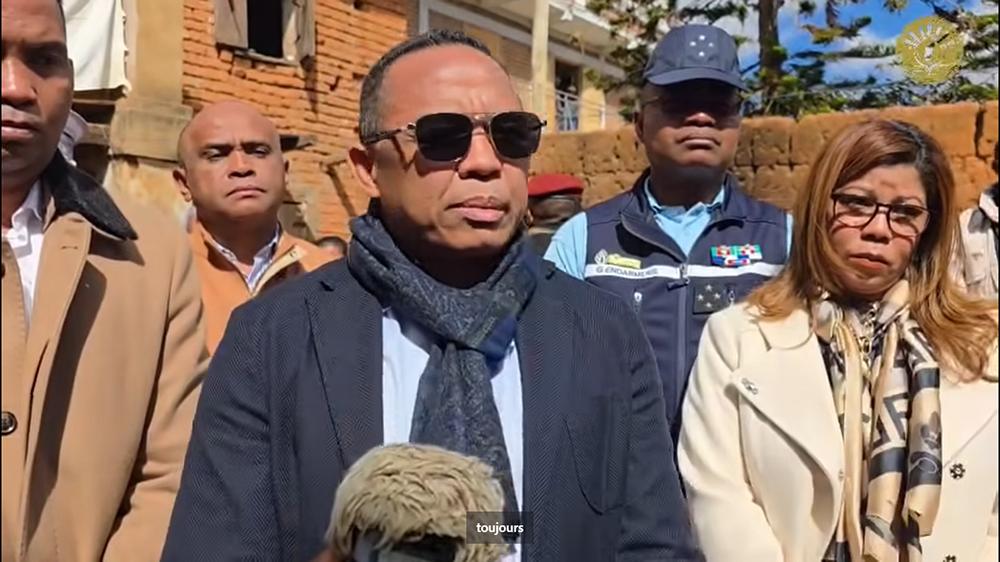
The rhetoric of political decision-makers regarding the security situation is hardening. After referring to a ‘climate of psychosis,’ the Head of State now compares current events to ‘terrorism.’
‘It is terrorism.’ This is the term used by Colonel Michaël Randrianirina, head of the State, to describe the wave of disappearances and macabre discoveries that have been making headlines in recent days.
‘It is truly unfortunate. We can no longer call this politics. It is no longer politics. It is what we call terrorism. The current situation amounts to terrorism,’ the occupant of Iavoloha stated yesterday, on the sidelines of offering his condolences and those of the government to the families of one of the missing persons found dead. ‘Are these acts intended to show the international community, or whoever else, that Madagascar is unstable?’ he questioned.
For several days, disappearances and crimes sometimes targeting children and adolescents have created fear among the public. The senior officer maintains the theory that the current resurgence of insecurity is caused by a destabilization maneuver. After speaking of a strategy to create a ‘psychosis’ climate on Saturday, the Head of State has intensified the political rhetoric by labeling the events as ‘terrorism.’
By linking these crimes to desires for destabilization, the authorities have given them a political dimension. In a statement on Tuesday, Prime Minister Mamitiana Rajaonarison described the situation as a ‘war’ against those who wish to destabilize the Refoundation. This semantic escalation in the speeches of political leaders to reclassify these criminal acts as a major national threat could be a way to indirectly justify the strengthening of security measures.
This hardline approach is reflected on the ground by the deployment of several battalions of the Defense and Security Forces (FDS). An operational command center has also been set up to develop and coordinate actions. The resumption of citizen vigilance committees is encouraged. Yesterday, Colonel Randrianirina indicated that the Presidency of the Refoundation of the Republic is ready to cover the necessary expenses.
The Executive also wants to fight the battle in the digital sphere. ‘It was decided during the Council of Ministers to take measures to block websites disseminating and propagating obscene images and videos that could disturb public order and are contrary to good morals in daily life,’ stated the press release published by the presidential institution on Tuesday. Yesterday, Colonel Randrianirina went as far as pointing the finger at ‘certain media’ outlets, which allegedly get the first scoop on current insecurity cases.
‘Some media also raise questions by publishing reports prematurely. There are even media outlets that seem to wait for these types of events, without going so far as to call them accomplices, since they are the first to broadcast this information. One gets the impression that they rejoice when a child disappears or is killed, by being the first to relay these facts,’ he declared.
The coincidence of the Head of State’s remarks with a wave of systematic attacks against some press organizations on social media is intriguing. Seeking to be the first to report information, to have ‘scoops’ in jargon, is, however, one of the objectives of every journalist. ‘Our private messages are flooded with requests to publish disappearance cases. We sort through them by cross-checking before any publication,’ a journalist explained.
In the current sensitive context, reflections on the balance between the duty to inform and editorial responsibility are essential. By overwhelming the press or seeking to block websites, the State touches on issues of law and freedom. The right of the press to inform and the right of citizens to be informed are at stake. There is also the question of freedom of expression, the press, and digital freedom. To a certain extent, this is a slippery slope.
In the debates, some observers fear the possibility that the authorities are looking for scapegoats to validate the conspiracy theory. In a statement published yesterday, the Antananarivo branch of the Syndicate of Teacher-Researchers and Researcher-Teachers (Seces) asks the authorities ‘not to be content with statements about the supposed objectives of the people who might be behind these facts…’
According to Seces Antananarivo, ‘the population expects the current power, a military power at that, to eradicate these acts at the root, and not just to arrest the small fish.’ Beyond the political rhetoric and potential reprisals, the performance of the State will be judged by the immediate and lasting results in terms of security.
Captured & Published at: 2026-07-09 06:12:52 (Madagascar Local Time EAT)
Original Source: https://www.lexpress.mg/2026/07/colonel-randrianirina-cest-du-terrorisme.html