
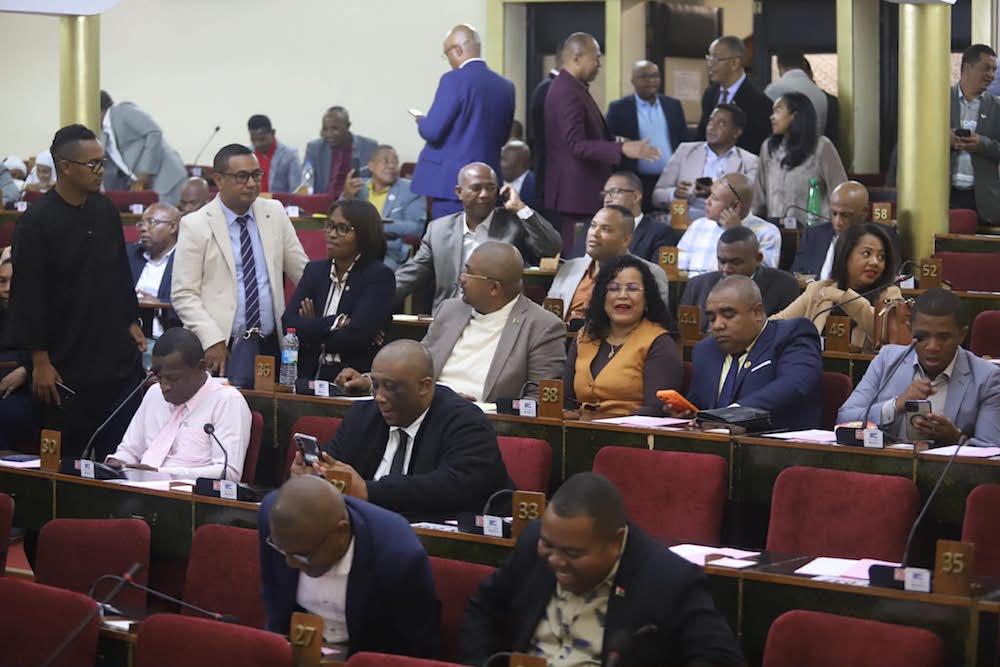
The National Assembly is set to begin an extraordinary session soon. This meeting will take place against a backdrop of tension due to the resurgence of insecurity.
Tense. This word summarizes the current socio-political situation in the country. It is in this heavy context that the extraordinary session of the National Assembly will begin—an impromptu session requested by deputies and formalized by a decree issued during Tuesday’s Council of Ministers meeting.
According to sources at the Lower House, the decree convening the extraordinary session has not yet reached Tsimbazaza. However, the regulatory act sets the date, agenda, and duration of the debates, which must not exceed twelve days. From the permanent bureau of the institution, there has been radio silence so far. During the first ordinary session, Siteny Randrianasoloniaiko, President of the National Assembly, had mentioned the need for an impromptu meeting to examine pending bills and proposals.
The announced extraordinary session will, however, be held against a backdrop of social tension—a situation strained by the resurgence of insecurity. Cases of disappearances and alleged murders, including those of children and adolescents, have been making headlines. Although a lull seems to have set in over the last three days, anxiety remains palpable among citizens.
From the Head of State and the Prime Minister to the heads of the Defense and Security Forces (FDS), the theory of a political plot to destabilize the country behind these acts of violence is being favored. The words “terrorism” and “war” have even been used by the two heads of the Executive to describe the current situation. At first glance, for the State, the fight against this current insecurity consists of waging a war against suspected terrorists.
“I warn that, whoever is behind this, we have already started investigating now. Whatever the organization, whatever is behind this, I will destroy it,” warned the occupant of Iavoloha in a speech delivered in Toamasina on Friday.
However, as the senior officer apprehended, a climate of psychosis has taken hold within society. Beyond political rhetoric, the security situation is creating a deleterious social environment.
The social tension is such that based on mere hearsay or public outcry, and in defiance of the presumption of innocence, individuals are being lynched or are considered “presumed guilty” of kidnapping or murder. Following the cases of disappearances, acts of mob justice have flooded social media over the last 72 hours. Yesterday, for example, a young man accused of murdering a young woman in Maintirano was snatched from police custody by a crowd, then lynched and burned alive.
Also yesterday, a trendy stylist denounced on social media an attack by individuals on a scooter, of which her driver was allegedly a victim. The current situation, which involves security and political stakes, is at the center of national concerns. For many observers, the current situation offers an opportunity for deputies to play their role of democratic enlightenment.
Beyond examining legislative texts, the National Assembly has an essential lever: the oversight of government action. Through oral questions and interpellations, parliamentarians have the opportunity to hold the Executive accountable. In such a sensitive context, their involvement could prove necessary. Beyond speeches, public opinion expects clear answers on the current situation.
Reacting to the authorities’ speeches, Dr. Omar Abderman Ramadany, a jurist and researcher-teacher, indicates that they “assume the existence of evidence, identified perpetrators, and elements sufficiently solid to justify such a qualification.” He explains, “(…) that a judicial investigation cannot be guided by hypotheses or declarations. It must be based on objectively established facts, serious clues, and evidence.”
The researcher-teacher points out the risk that prematurely attributing these crimes to political motivation, “without judicial demonstration,” could lead investigations in the wrong direction. “Faced with this security crisis, citizens expect neither speculation nor unproven accusations. They expect results: effective investigations, identified perpetrators, arrests, fair trials, and effective protection of the population,” he adds.
By asking the right questions and demanding precise answers, deputies can help clarify the gray areas surrounding the current situation, reassure the population, and soothe the ambient social tensions. Beyond flushing out those behind these crimes, the challenge is also to restore social peace.
Captured & Published at: 2026-07-13 21:34:13 (Madagascar Local Time EAT)
Original Source: https://www.lexpress.mg/2026/07/assemblee-nationale-une-session.html