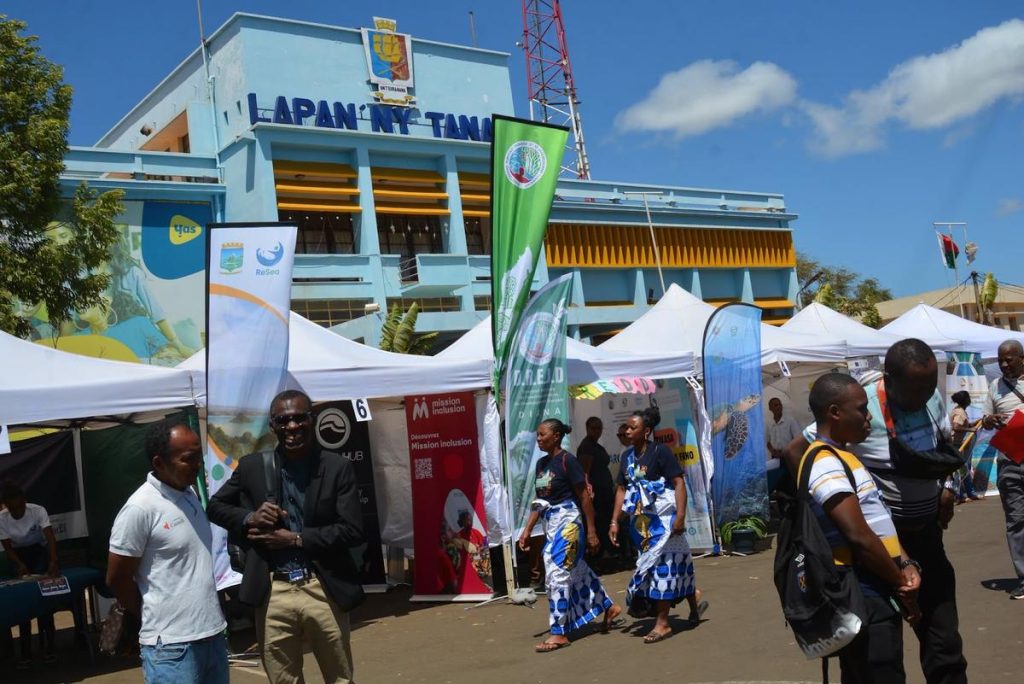
In Antsiranana, the conclusion of the ‘Regenerative Seascapes for People, Climate and Nature’ (ReSea) project took a forward-looking turn with a Blue Entrepreneurship Fair held on the Place Foch esplanade.
For two days, ten groups from the coastal communities of Antsiranana-II, mostly composed of women, showcased their products, expertise, and activities developed around marine and coastal resources.
Beyond the fair atmosphere, a fundamental question arises: what will remain of ReSea once the project officially ends? The true success will now depend on the beneficiaries’ ability to transform the project’s gains into economically viable and sustainable activities.
Part of the Great Blue Wall initiative and funded by the Canadian government, ReSea has supported coastal communities in several Indian Ocean and East African countries, including Madagascar, Comoros, Kenya, Tanzania, and Mozambique. In Antsiranana-II, the project focused on groups engaged in various value chains related to the blue economy.
The fair highlighted products such as processed seafood, fattened crabs, and processed shrimp. Local specialties like ‘Laoko sira’, ‘saly maiky’, ‘drakatra’, and ‘makamba rano’ illustrate the desire to add value to resources locally.
The goal goes beyond simple product display. Meetings with buyers, financial institutions, technical partners, and public authorities are intended to help beneficiaries find new market outlets and consolidate their operations.
The real challenge now lies in transitioning from a supported initiative to a truly viable economic activity. Production is not enough; it requires consistent sales, quality improvement, proper preservation and packaging, access to financing, and structured marketing channels.
For women in coastal communities, this is particularly significant. Strengthening a group or securing regular buyers can enhance their economic autonomy, benefiting households and the local economy.
In the Diana region, where many depend on the sea, the issue is critical. While fishing, processing, trade, and tourism offer significant potential, several links in the chain need strengthening to ensure local populations capture the value.
The challenge is also environmental. Marine ecosystem protection cannot be sustainable without viable economic activities for the communities that depend on them. Conversely, economic activity that degrades resources compromises its own future. The goal is to create value while preserving ecosystems.
ReSea aims to shift communities from being mere beneficiaries to becoming actors in their own development. The equipment, training, and support provided are assets, but their true value will be measured by their long-term impact.
Sara Emery, manager of the ReSea program in Madagascar and Comoros, noted that the sale of nearly all products presented is an encouraging sign. She views this dynamic as the ‘start of new adventures’ for the communities, particularly regarding ecosystem preservation.
‘The closing of ReSea should not be seen as an end, but as a passing of the baton. The next challenge is to maintain the momentum, expand market access, mobilize funding, and allow activities to gradually gain autonomy,’ she stated.
In Antsiranana, the fair raised the question of the post-project era. The sea is both a resource to be preserved and a source of jobs and income. The challenge now is to sustain this momentum beyond ReSea.
Captured & Published at: 2026-09-22 05:53:58 (Madagascar Local Time EAT)
Original Source: https://www.lexpress.mg/2026/09/antsiranana-les-communautes-cotieres.html