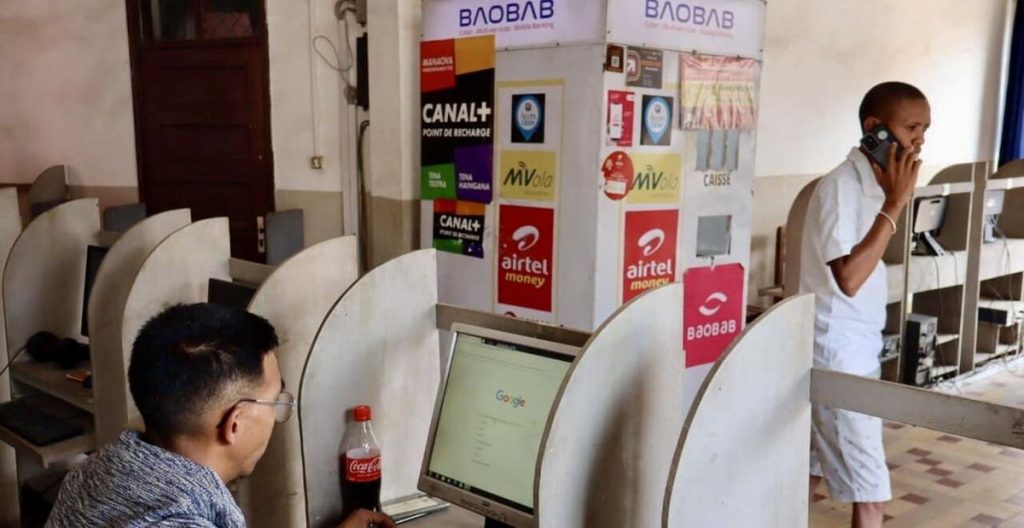
In Madagascar, the development of mobile internet is entering a decisive acceleration phase. The country now benefits from extremely broad network coverage, the result of twenty years of massive investment in cutting-edge infrastructure. However, while technology is well-deployed across the territory, the penetration rate still needs to improve. How can this gap be explained, and what are the real challenges to ensuring better digital inclusion? An analysis.
To understand the current Malagasy telecommunications landscape, one must measure the progress made over the last two decades. The market is now one of the most dynamic in the region, driven by competition among five major players, including global giants like Orange and Airtel, as well as satellite providers like Starlink.
The current market structure is not a static legacy, but the result of competition through investment. For instance, when the incumbent operator was privatized in 2004, it was heavily indebted and held less than 10% of the market share. Its current leadership is the direct result of over $950 million in investments by the Malagasy firm YAS. This continuous effort has provided the country with thousands of kilometers of fiber-optic network, covered over 88% of the population with 4G, and made Madagascar one of the pioneers of 5G in Africa as early as 2020.
The development of these infrastructures takes place within a strict and transparent regulatory framework, ensuring market fairness. The Communications Technology Regulatory Authority (ARTEC) rigorously oversees the sector. Whether regarding wholesale prices for access to the national fiber-optic backbone or interconnection pricing rules (On-Net and Off-Net calls), price ceilings and terms are regulated.
If infrastructure is present and regulated, where is the bottleneck for digital inclusion? As GSMA studies in Africa regularly demonstrate, the main barrier is no longer network availability, but the financial accessibility of devices. In Madagascar, access to smartphones faces a double obstacle: limited purchasing power, heavily penalized by some of the highest taxes on the continent. Cumulative taxes (customs duties, VAT) on the import of entry-level smartphones, coupled with service taxes (8% excise duty on telecoms and 5% on mobile finance), keep the cost of digital access out of reach for a large segment of the population.
On the service side, operators have initiated unprecedented efforts to democratize data access. Between December 2025 and February 2026, mobile internet rates saw a historic drop, reaching an average of -55%, with fiber access offers up to -80% in the case of the YellowOne offer, one of the most competitive in Africa. These price cuts are particularly notable as they occur in a degraded economic context. In Madagascar, inflation remains high (estimated between 8% and 9% in 2026), while telecommunications equipment and infrastructure are imported and paid for in US dollars. It is worth noting that the telecom sector is one of the few to have lowered prices for the end consumer despite the general rise in the cost of living.
The infrastructure is there, data price cuts are effective, and the market is open. For Madagascar to reach a new milestone and make digital technology a true engine of economic growth, the next lever is fiscal. An incentive policy, particularly through the elimination of additional taxes on telecoms and a reduction in taxation on affordable smartphones, would transform network coverage into a truly connected society. The key to the Malagasy digital future lies in this partnership between private operator investments and a public fiscal vision favorable to inclusion.
Captured & Published at: 2026-10-06 15:08:33 (Madagascar Local Time EAT)
Original Source: https://www.lexpress.mg/2026/10/madagascar-internet-mobile-quels-enjeux.html