By 2040, Madagascar aims to revitalize its agricultural sector to serve as the primary engine for shared prosperity. To achieve this, the Great Island is focusing on the local processing of its products.
The challenge has been set. In its new agricultural and food sovereignty policy for 2040, Madagascar intends to fully exploit its agricultural potential. Authorities plan to stimulate crops with high industrial processing potential. According to projections in this roadmap, these sectors are expected to generate over 500,000 jobs and inject $800 million into the national economy, with a particular focus on rice, maize, sugarcane, bananas, and cotton.
According to Ministry of Agriculture figures, current rice production stands at 5,250,000 tons, yet national consumption still requires imports of around 500,000 tons annually. Madagascar aims to reach a production of 11,256,000 tons of rice by 2030. For maize, the country plans to increase annual production from 450,000 tons—insufficient to meet local industrial needs—to 1.5 million tons by 2030, with an export capacity target of 600,000 tons.
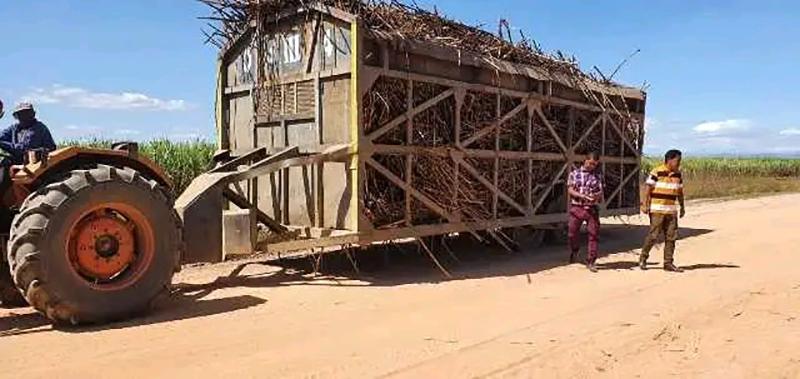
For the sugarcane sector, authorities project producing 350,000 tons of sugar within four years. Current production is estimated at 2.7 million tons of sugarcane, yielding 150,000 tons of sugar. Bananas have been a historic export for the Great Island for over five decades. Current production is around 350,000 tons, of which 250,000 tons are exported by companies such as Sobena or MafRob.
“The goal is to reach 600,000 tons by 2030, with an exportable volume of 450,000 tons valued at $262 million,” the national agricultural policy specifies. The same applies to cotton, a currently precarious sector where an industrial revival has begun. The stated goal is to produce 90,000 tons of fiber, or 200,000 tons of cottonseed, to generate $42 million in exports. To date, however, Malagasy agriculture remains characterized by high precariousness and a low rate of mechanization.
Industrial-scale production would create added value for Malagasy products, bridge local market deficits, and export surpluses. “Madagascar is at a turning point in its agricultural sector: transforming traditional practices to meet the challenges of climate change, rural poverty, and food security requires shifting to modernized, mechanized agriculture equipped with improved varieties and better irrigation,” the strategic document emphasizes. The text insists on the need for a break: “The country must move away from the subsistence model by promoting competitiveness and integration into value chains […]. To make agriculture and livestock resilient and prosperous, Madagascar must adopt fluid, integrated policies geared toward innovation and sustainability. This requires coherent governance, with stable public policies favoring agroecology, digitalization, and diversification.”
Captured & Published at: 2026-07-25 05:53:33 (Madagascar Local Time EAT)
Original Source: https://www.lexpress.mg/2026/07/transformation-locale-lagriculture.html