
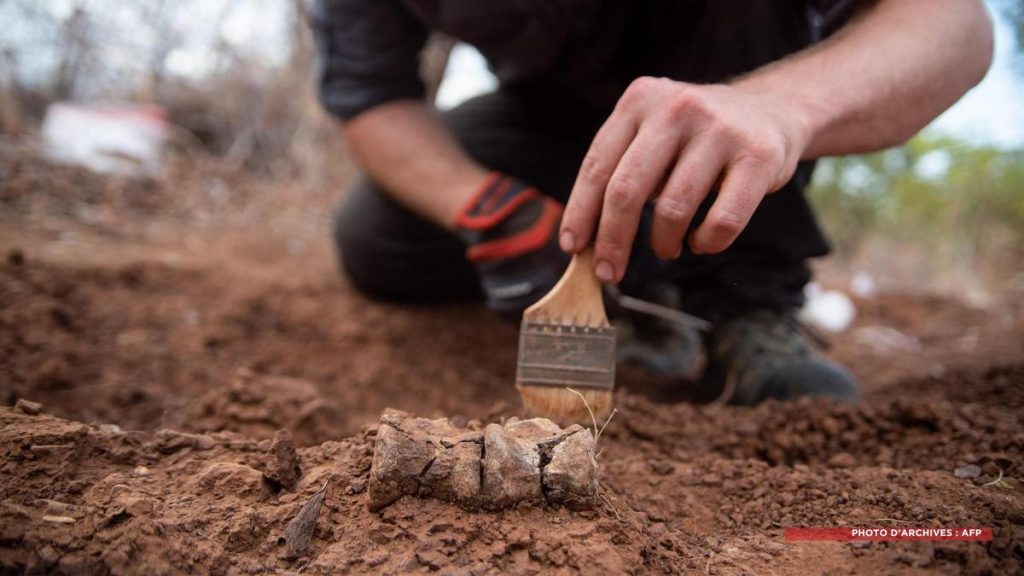
An international team of paleontologists has announced the discovery of a new dinosaur species in Zimbabwe. Named Musango matusadonaensis, this animal, which lived approximately 210 million years ago, is the fifth dinosaur species identified in the country. Researchers believe this discovery also provides new insights into the diversification of early dinosaurs in Southern Africa.
The fossil comes from a skeleton unearthed in 2018 on the shores of Lake Kariba, in northern Zimbabwe. The work, led by British, Zimbabwean, and South African scientists, was published in the scientific journal Journal of Systematic Palaeontology.
According to the researchers, Musango matusadonaensis lived during the Late Triassic period, a time when dinosaurs were beginning to spread across the Earth without yet dominating terrestrial ecosystems. An early ancestor of large dinosaurs like the Diplodocus, it walked on two legs, measured about 4.5 meters in length, and weighed an estimated 222 kilograms. Its name, derived from the chiShona language, means “the one that lives in the bush.”
The fossil is among the most complete dinosaur skeletons from that era found in Zimbabwe. Paleontologists recovered well-preserved bones from the spine, ribs, forelimbs, hindlimbs, and feet. The animal, which was about eight years old at the time of its death, was almost fully grown. Analysis of its bones indicates that it had survived a serious injury or infection. As its skull was not found, researchers estimate it was likely an herbivore or omnivore.
Beyond the identification of this new species, scientists believe this discovery challenges the idea that dinosaurs in Southern Africa formed a relatively homogeneous fauna. According to Paul Barrett, a researcher at the Natural History Museum in London, the various discoveries made in Zimbabwe suggest that this region of the ancient supercontinent Gondwana was composed of several small ecosystems, each harboring distinct species.
Researchers conclude that early dinosaurs may have evolved simultaneously in varied environments, which would have favored their diversification much earlier than previously thought. They also estimate that the fossils already discovered likely represent only a fraction of the diversity of dinosaurs that lived in this region.
In 2022, scientists had already identified Mbiresaurus raathi in Zimbabwe, considered one of the oldest known dinosaurs in Africa. This species, dating back about 230 million years, stood nearly a meter tall, had a long tail, and weighed less than 30 kilograms.
Captured & Published at: 2026-07-30 18:53:44 (Madagascar Local Time EAT)
Original Source: https://2424.mg/paleontologie-une-cinquieme-espece-de-dinosaure-identifiee-au-zimbabwe-une-decouverte-qui-eclaire-levolution-des-premiers-dinosaures/?utm_source=rss&utm_medium=rss&utm_campaign=paleontologie-une-cinquieme-espece-de-dinosaure-identifiee-au-zimbabwe-une-decouverte-qui-eclaire-levolution-des-premiers-dinosaures