
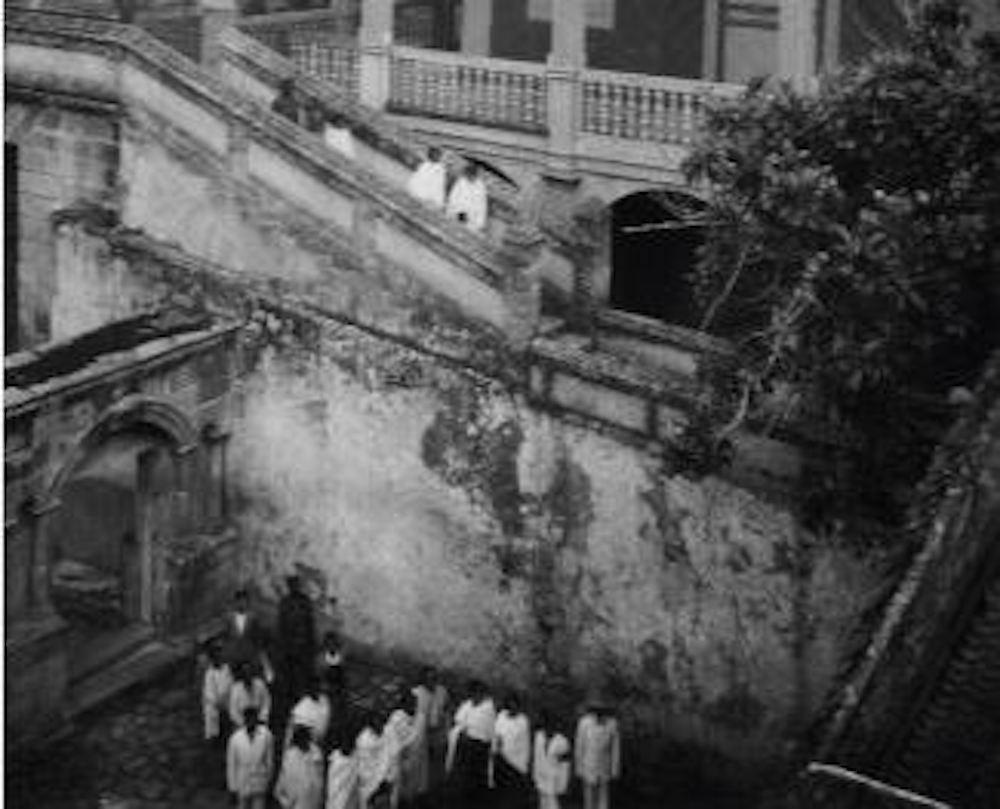
The Rova of Andrianampoinimerina in Antananarivo contains no more structural elements than that of Andrianjaka, except for the court of justice. In 1800, it was a roughly rectangular space limited to the north by the terrace overlooking Tranovola, and to the west by the current Queen’s Palace, along which a steep slope with a retaining wall still existed in 1817, but has since been filled in. The northern access must have been at the location known since the reign of Ranavalona I as the “Ileodoka gate,” which was oriented differently and built of wood at the time.
According to the “Tantara ny Andriana eto Madagascar” (History of the Kings of Madagascar) by Father Callet, there was only one access point at the time, as the southwest gate dates back to that queen. “This Rova served requirements other than the simple convenience of the sovereign. Security first: the fear of death, so deep in the Malagasy soul, had solid justifications then,” wrote Vincent Belrose Huygues in his study on the Rova of Tananarive. The Rova, situated at the summit of the city, “solidly barricaded and guarded,” prevented any attempts on the king’s life. This precaution was renewed around every Lapa (palace) or group of palaces.
“Even more important was the symbolic requirement.” The “Tantara” indicate that at the time, the Rova was easy to climb, so a rigorous law was enacted. Thus, one had to enter through its single gate, and passing over the palisade was forbidden on pain of death. This law was meant to ensure the sovereign’s safety, but to pass through the gate, one had to perform a series of ritual gestures to prove a state of purity and ward off bad luck.
“We find here an architectural model of archaic sacral royalty, the principles of which are found as much in Cretan-Mycenaean royal enclosures as in those of the great kingdoms of West Africa and, closer to home, Zimbabwe: the royal enclosure marks the boundary from which multiple prohibitions operate,” explains Belrose Huygues, adding: “The material and symbolic structure of the Rova reveals a division between a male and political pole, and a female and religious pole.”
He specifies that the first enclosure is a privileged area where the sovereign is close to the receptacle of the monarchy’s vital force (“hasina”) and the support of his legitimacy, namely the tombs of his ancestors. This is why the residence and presence of certain social categories deemed impure (women, Olomainty, Andevo) were forbidden there, as “it is a space of purity.” The second enclosure consisted of the residences of the women who symbolized idols and sacred oxen, all charged with the ritual protection of the sovereign.
In reality, the author writes, the opposition is not between political and religious; the “hasina” (sacred power) of the ancestors, which is embodied in the reigning sovereign and accumulates in the tombs, is of a religious nature, while the choice of the twelve royal wives was certainly of a political nature. “Thus, thanks to the Rova, the relationship to the sacred remains constantly apparent.” This is also why Malagasy kings were reluctant to abandon or neglect the edifices of their predecessors who had become ancestors. If the “Lapa” fell into ruin, they kept the name and gave it to a new construction, as was the case with Besakana, which was rebuilt several times.
To all this, the reign of Andrianampoinimerina seems to have added important practices known well before him. While, in general, all buildings were oriented north-south, in the Rova, they were oriented north-south relative to magnetic north. But the influence of astrologers in Antananarivo was not limited to the orientation of homes. It determined the relative position of the royal “Lapa” within the enclosure.
Belrose Huygues describes that Andrianampoinimerina’s four houses were arranged around the tombs “like a hearth.” The southeast sector was avoided; to the south was Soaniadanana, a residence of little importance but necessary to mark the sector; to the north Manjakandriana, to the northwest Marivolanitra, where the king resided continuously, and to the northeast Manatsara. “Now, the north side of the hearth is considered the place of honor.” Finally, astrological requirements seemed to be stronger in the capital than in Ambohimanga. Andrianampoinimerina and later Radama I surrounded themselves with Antemoro soothsayers and scribes who regulated their lives and movements.
Captured & Published at: 2026-07-06 07:42:51 (Madagascar Local Time EAT)
Original Source: https://www.lexpress.mg/2026/07/entre-pole-masculin-politique-et-pole_01631910710.html