
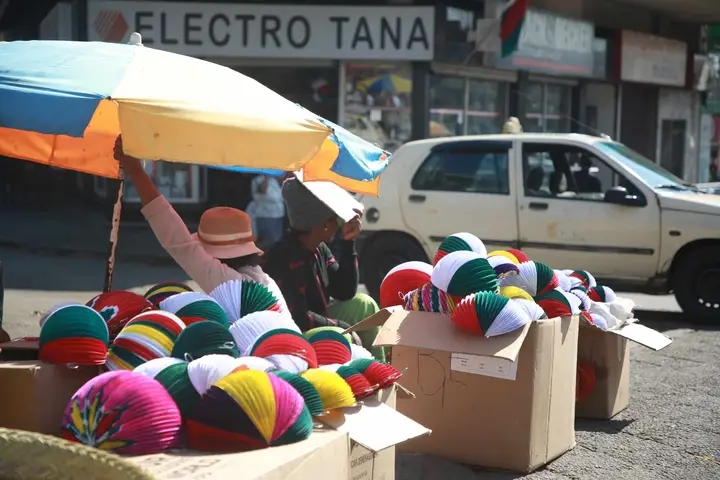
As June 26 approaches, artisanal lanterns and Chinese-made models are competing for space in the capital’s markets, reflecting a mix of national pride and consumer pragmatism.
With the approach of National Day, artisanal lanterns and Chinese-manufactured models are flooding the markets of the capital, particularly in Analakely, Tsaralalàna, Isotry, Anosibe, and several other commercial districts. Children and parents alike have their own preferences. While imported products remain highly popular, some households are choosing to return to artisanal lanterns to support local craftsmanship.
Prices at the stalls range from 500 to 15,000 ariary, or even 20,000 ariary for larger models. Made from paper, wire, and a small internal candle holder, locally crafted lanterns are winning consumers back. The paper is carefully folded by hand before being assembled onto a metal frame or rigid cardboard support. Models featuring the colors green, white, and red remain the most sought after. Others, depicting animals or inspired by cartoon characters, are particularly appealing to children.
For now, foot traffic remains moderate. “Those who want to decorate their balconies are the first to buy in bulk,” explains Narindra, a lantern vendor in Analakely. She has, however, observed a renewed interest in paper lanterns, which she attributes to improvements in quality and a wider variety of designs.
Original Designs
“I buy locally made products because it’s our National Day. It’s true that Chinese lanterns are numerous and attractive, but they aren’t durable, yet they are expensive. I haven’t bought them for two years now, and my children are getting used to Malagasy lanterns,” says Nokoloina, a mother.
The “arendrina” (lanterns) come in various shapes: square, rectangular, round, and more. In recent years, artisans have developed more original models, shaped like accordions, fish, or inspired by cartoon characters. Each lantern includes a small holder where parents place a candle to light the children’s path in the early evening.
In the past, the traditional Malagasy lantern consisted of a long stick with an end wrapped in straw, cloth, and jabora (tallow). Once lit, it was carried through villages and neighborhoods. Children would walk the streets at nightfall, accompanied by musicians playing instruments like the langoroa (drum), angorodao (accordion), or sodina (flute).
Nonetheless, some consumers continue to favor Chinese lanterns, which they consider more resilient. According to them, a single purchase can last for four years, as the lanterns are carefully stored after each celebration for reuse in the following years. This year, new models have already appeared in the markets.
“Arendrina taratasy ô, may, may, may…” This famous refrain accompanies children every year on the evening of June 25, the eve of the National Day celebration. It is a tradition that continues to keep the festive spirit alive.
Fireworks and lasers remain widespread
A few days before the June 26 festivities, firecrackers, laser pointers, and similar devices remain widely available in the capital’s markets. However, the Antananarivo Police Prefecture has confirmed their ban throughout its jurisdiction. This measure aligns with the provisions announced nationally by the National Technical Committee in charge of organizing the 66th anniversary of the return of independence. Authorities remind the public that this ban is intended to ensure safety and the smooth conduct of the celebrations.
Mialisoa Ida
Captured & Published at: 2026-06-24 06:01:22 (Madagascar Local Time EAT)
Original Source: https://www.lexpress.mg/2026/06/fete-nationale-les-lampions-artisanaux.html