
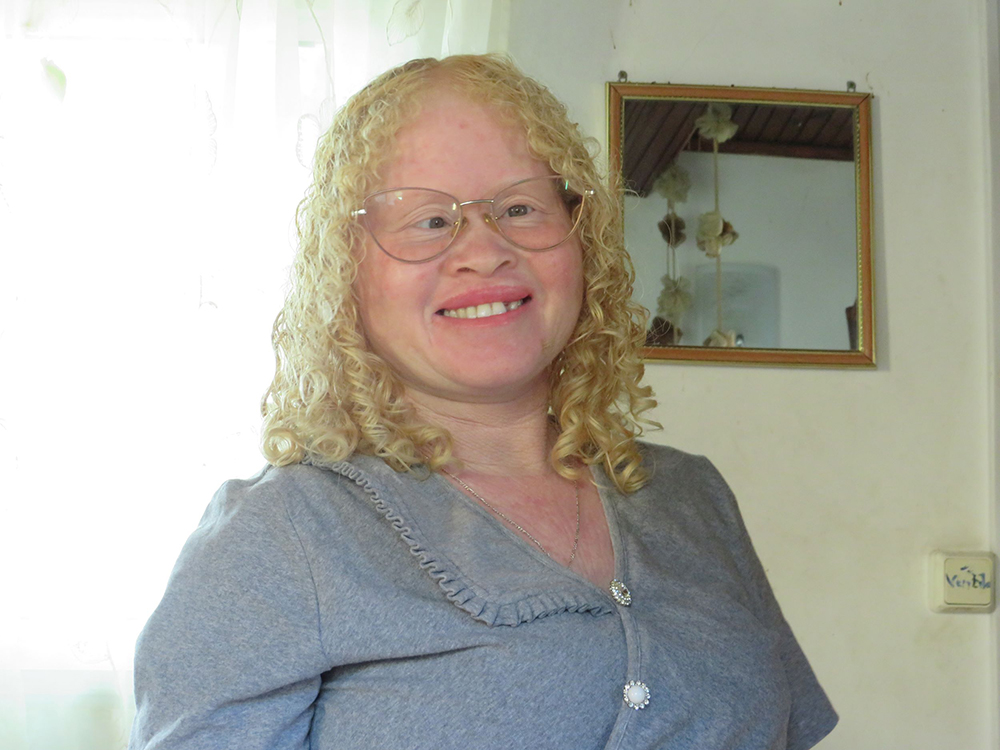
Living with albinism, Christine Roland Manana presides over the Association of People with Albinism in the Atsimo Andrefana region. Committed to defending the rights of her peers, she fights against their social exclusion and denounces the beliefs that fuel the discrimination and violence they face.
Tell us a little about yourself.
I am 34 years old, married, and a mother of two daughters. Neither my husband nor our children have albinism. Holding a law degree from the University of Toliara, I currently serve as the head of the “social inclusion” department, a role recently established within the Atsimo Andrefana region. Previously, I was an assistant at the General Affairs Directorate. I have lived in Toliara since I was three. Since 2022, I have been actively involved with the Association of People with Albinism in the Atsimo Andrefana region to defend our rights and ensure our voices are heard.
Since the discovery of the young child with albinism’s body in Antsihanaka, Toliara, there has been a lot of talk about you and your association. Is this a good or bad thing?
It is both positive and negative. On one hand, this media attention sheds light on our situation. On the other, it reminds us of a painful reality: we constantly live in fear of being kidnapped, held hostage, or murdered because of our skin color. This is why we often avoid drawing attention to ourselves. However, we are indeed being discussed as vulnerable people who need support. Celebrating International Albinism Awareness Day on June 13th gave us the opportunity to amplify our plea regarding the extremely difficult conditions faced by people with albinism.
What do you think of the beliefs that people with albinism possess supernatural powers or exceptional characteristics?
In the South in particular, some believe our eyes contain diamonds or that we can see in the dark like cats. Others claim our organs have special virtues, that our blood is blue, or that beheading a person with albinism brings wealth. Kidnappings and crimes against people with albinism are unfortunately not new. The recent murder of the baby with albinism in Toliara is a tragic illustration, but we often remain unaware of what happens in remote areas. Some victims are killed in ritual crimes, others after kidnappings when ransoms are not paid, and others are simply rejected or assaulted because of their skin color. If my eyes contained diamonds, I would have sold them a long time ago! And if we truly brought wealth or luck, I would be a billionaire by now.
Can you set the record straight on these misconceptions?
The reality is quite different. People with albinism generally suffer from vision problems. Personally, in school, I always asked to sit in the front row because I had trouble distinguishing what was written on the board. Our blood is red, and our organs are perfectly normal. We possess no supernatural powers and are not descended from ghosts. I do not understand how some people can still believe our death could bring wealth or prosperity. We are human beings like everyone else. The only difference is that our skin lacks or has insufficient melanin, the pigment responsible for skin coloration.
What is the daily life like for a person with albinism?
We remain largely excluded from society. For instance, it is very difficult for many of us to access employment, which plunges many in our community into poverty. In some rural areas, people with albinism are forced to seek refuge with the gendarmerie for their own safety. They cannot work and often become dependent on their relatives. This is not a normal life.
The Ministry of Population has set up a reception center in Toliara for people with albinism. Do you think this is a solution?
It is a positive initiative. Parents can keep their children safe there. However, for adults who are parents themselves, the question remains: must we also live in this center? We have families to support and we must work, even in small jobs. Therefore, I cannot say that this center is a long-term solution.
What are your association’s most urgent needs today?
Not all people with albinism in the Atsimo Andrefana region have been registered. We cannot go to certain rural areas where the risk of kidnapping and murder is particularly high. Our members need employment opportunities, but above all, they need to be fully accepted in society. The best solution remains to consider us as full citizens, with the same rights and dignity as everyone else.
Mirana Ihariliva
Captured & Published at: 2026-06-20 06:30:21 (Madagascar Local Time EAT)
Original Source: https://www.lexpress.mg/2026/06/christine-roland-manana-les-croyances.html