
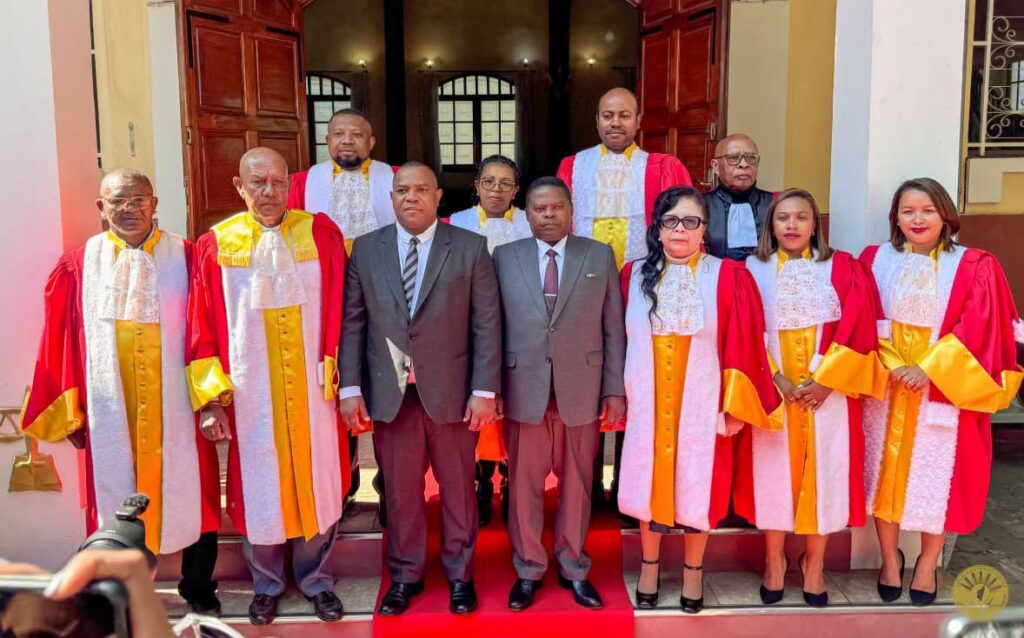
The two new members of the High Constitutional Court (HCC), elected by the National Assembly, were sworn in yesterday. Their inauguration brings the number of high constitutional councilors installed by the ‘Refoundation’ power to five out of nine.
The epilogue. Faralahy Célestin Razafindramasy and Honoré Vazison, the two new high constitutional councilors elected by the National Assembly, took their oaths yesterday during a formal session at the High Constitutional Court (HCC) in Ambohidahy.
Yesterday’s ceremony may signal the conclusion of the series of upheavals that have shaken the Ambohidahy institution in recent weeks. The entry into office of the two new constitutional judges marks a shift in the political wind blowing over the HCC. While there is the principle of separation of powers, as well as the impartiality and independence of the members of the Constitutional Court from the entities that designated or elected them, political compatibility remains a significant factor behind the scenes in the selection of those appointed or elected.
Like their predecessors, the holders of the ‘Refoundation’ power are securing an institutional stronghold and ally by replacing the majority of HCC members. Out of the nine high constitutional councilors, five have now been installed by the ‘Refoundation’ power: the three appointed by the Head of State, Colonel Michaël Randrianirina, in December, and the two elected by the Lower House who have just been sworn in.
The only HCC members installed during the previous regime are the two female magistrates elected by the Senate. They are unlikely to be replaced, as the election of new members for the Upper House will wait for the 5th Republic. Additionally, there are the two constitutional judges elected by the High Council of the Judiciary (CSM), including Florent Rakotoarisoa, president of the Ambohidahy institution.
Orders, decisions, or opinions from the Ambohidahy institution are preceded by deliberations among its members, concluded by a vote. “In the event of a tie, the president’s vote is decisive,” states the ordinance concerning the HCC. This highlights the importance for political decision-makers to ensure they have “allies” within the Constitutional Court.
Electoral Jurisdiction
Florent Rakotoarisoa disavowed former president Andry Rajoelina—to whom he was once reputed to be loyal—during his speech at Colonel Randrianirina’s swearing-in ceremony on October 17, 2025.
Judging by recent events, a non-compliant HCC inconveniences political decision-makers. For instance, the resigning constitutional judge, Nandrasana George Merlin Nasolo, indicated he had begun the resignation process three months ago due to a work environment that no longer suited him. Another example is the National Assembly’s intention to replace its two former representatives at the Ambohidahy institution at the end of May, citing “a realization of resistance making collaboration difficult.”
Furthermore, there were prosecution orders issued against four members of the Ambohidahy institution, including the two who recently resigned, for “conspiracy to destabilize.” As indicated by Fanirisoa Ernaivo, Minister of Justice, on the sidelines of an event in Analakely on June 1, they allegedly issued a favorable opinion on the admissibility of the petition filed against the Head of State by Deputy Rajerison Antoine Randriamampianina during their deliberations.
The stakes regarding the configuration of the Constitutional Court also rest on its role as a constitutional jurisdiction. In the Republic’s ‘Refoundation’ program submitted to the Southern African Development Community (SADC), it is planned that “a special jurisdiction or judicial body, endowed with the necessary independence, shall be established with competence to hear electoral disputes and proclaim final election results.”
This special legal entity is intended to replace the HCC as the electoral jurisdiction. Much like the establishment of a new body to organize elections in place of the Independent National Electoral Commission (CENI)—whose members have also been replaced—the decision will ultimately depend on national consultation. This implies moving beyond the framework established by the Ambohidahy institution’s decision on October 14, 2025, which provided the constitutional blessing for the ‘Refoundation’ power.
As it stands, much like the CENI, it is likely that the current HCC, in its present configuration, will rule on election disputes and proclaim the results of the referendum or constitutional election that will mark the entry into the 5th Republic, and potentially the subsequent presidential election. This is especially relevant given that the non-renewable seven-year mandate of its members, which began on April 8, 2021, runs until April 2028.
Captured & Published at: 2026-06-20 06:01:29 (Madagascar Local Time EAT)
Original Source: https://www.lexpress.mg/2026/06/institutions-une-hcc-taillee-la-mesure.html