
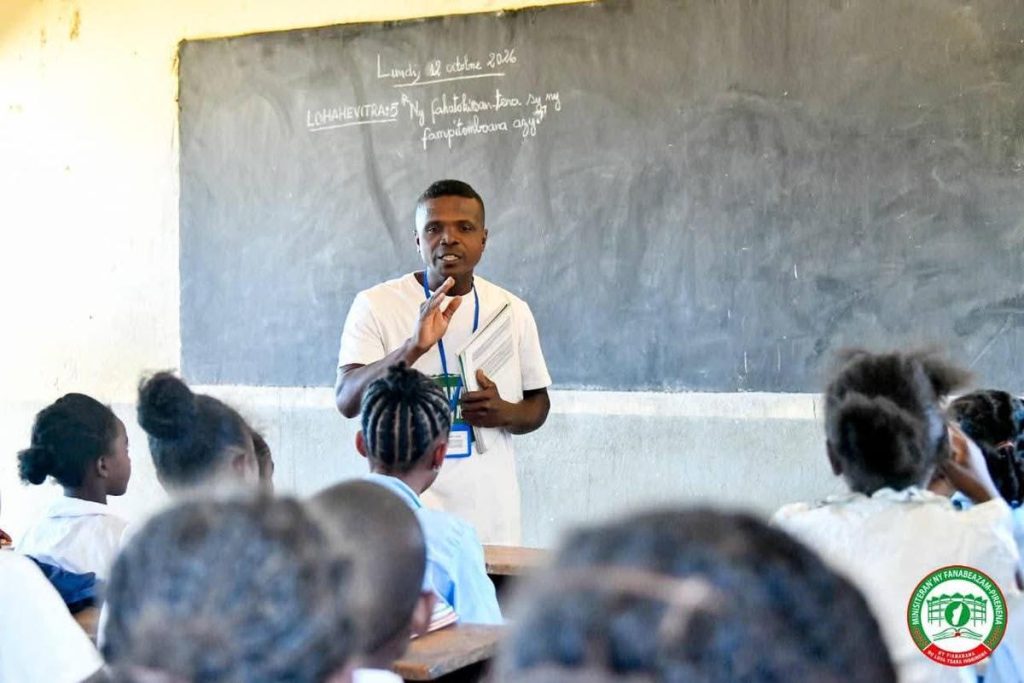
Teaching future generations requires much more than just mastering a subject. In Madagascar, despite salaries that are sometimes meager compared to their responsibilities, teachers continue to work, driven by the vocation to transmit knowledge and educate.
Being a teacher means accepting a responsibility that does not end with school hours. Preparing lessons, finding the right methods to ensure understanding, supporting struggling students, and contributing to their upbringing are all tasks that require patience, availability, and self-sacrifice. In Madagascar, this mission continues despite the difficulties of the profession, particularly regarding wages.
“Beyond the training to become a teacher, you need dedication and self-confidence,” emphasizes Nomena, a teacher. Pedagogical training provides the foundation, but the practice of the profession requires a daily commitment. Each student learns at their own pace, and the teacher must know how to adapt explanations, prepare exercises, and find ways to impart knowledge.
For a private school administrator, the journey begins long before the first lesson. Vocation must be accompanied by training, mastery of pedagogical tools, and the necessary authorizations to teach. A requirement that reminds us that teaching cannot be improvised. However, skills are not enough. Mrs. Sarindra, a mother of a child in a private school, expects teachers to also be educators. “It is not easy to pay tuition fees, so it is normal for us parents to expect quality teaching,” she notes.
In the Malagasy public education system, situations vary by status. Since July, civil servant teachers have received a chalk allowance of 150,000 ariary, in addition to the housing allowance of 200,000 ariary paid to all civil servants. “It’s a good thing, but it remains insufficient: this amount does not cover the rent for a two-room house,” says Bruno, a teacher at a public high school. Nivo, an English teacher at a middle school, buys her own boxes of chalk because the ones provided by her school are too dusty and make her cough.
The FRAM teachers, recruited by parent associations, are particularly vulnerable. A 2025 International Monetary Fund report highlights that subsidized FRAM teachers receive, on average, significantly lower compensation than civil servants. Subsidized teachers at the preschool and primary levels receive 150,000 ariary, middle school teachers receive 180,000 ariary, and high school FRAM teachers receive 200,000 ariary, paid every two months. For those relying directly on family contributions, the situation is even more precarious, with some earning as little as 80,000 or even 60,000 ariary per month.
Despite these constraints, many continue to teach because they believe in the importance of education. However, vocation should not be used to justify precariousness. Recognizing the calling of teachers also means guaranteeing them a dignified salary, decent working conditions, and the means to fulfill their mission.
Captured & Published at: 2026-10-21 05:38:42 (Madagascar Local Time EAT)
Original Source: https://www.lexpress.mg/2026/10/vocation-enseigner-un-veritable.html