
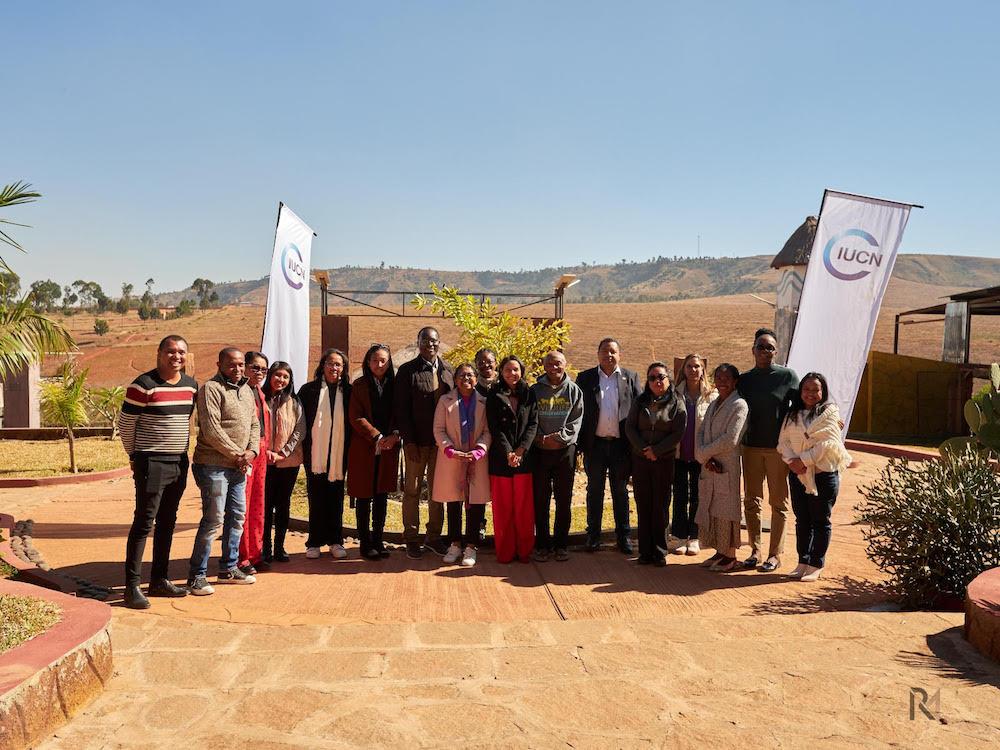
Actors in biodiversity conservation have reaffirmed their commitment to better coordinating their actions in order to better protect Madagascar’s natural heritage.
Faced with threats to Malagasy biodiversity, including deforestation, ecosystem degradation, invasive alien species, and climate change, the International Union for Conservation of Nature (IUCN), its National Committee, the Ministry of Environment and Sustainable Development (MEDD), and their partners organized a national workshop for the coordination of conservation stakeholders. The objective is to strengthen synergies between institutions, align interventions with the National Biodiversity Strategy and Action Plan (NBSAP), and accelerate the implementation of Madagascar’s international commitments.
Green jobs
According to Tojotsara Ratefason, Director of Protected Areas, Renewable Natural Resources, and Ecosystems at the MEDD, the numerous IUCN projects in Madagascar must be more harmonized with the Government’s priorities. She emphasized that biodiversity protection cannot be sustainable without concrete benefits for local communities. To this end, future projects will need to integrate the promotion of human capital, the creation of green jobs, and the improvement of livelihoods so that populations become the primary beneficiaries of conservation.
The workshop also served to present Madagascar’s expectations regarding the protection of species, forests, and ecosystems to IUCN representatives, while also electing Manantsoa Tiana Andriatsihoarana as head of the Executive Committee of the IUCN Madagascar National Committee, tasked with strengthening the coordination of conservation actions.
For his part, Luther Anukur recalled that the IUCN brings together States, NGOs, and various organizations committed to nature protection. He highlighted that the organization is already supporting several programs in Madagascar through technical and financial support, particularly in the protection of forests and marine ecosystems.
The President of IUCN Africa also noted that Madagascar is home to nearly 5% of the world’s biodiversity. For him, this natural wealth is a true lever for sustainable development, provided that environmental conservation is better linked to economic development, job creation, and the improvement of population incomes.
At the conclusion of the proceedings, the participants reaffirmed that the preservation of Malagasy biodiversity relies on collective action, better coordination between actors, and strengthened partnerships, with the ambition of reconciling nature protection and sustainable development for the benefit of communities.
Captured & Published at: 2026-07-04 06:13:24 (Madagascar Local Time EAT)
Original Source: https://www.lexpress.mg/2026/07/biodiversite-luicn-parle-dune-seule-voix.html