
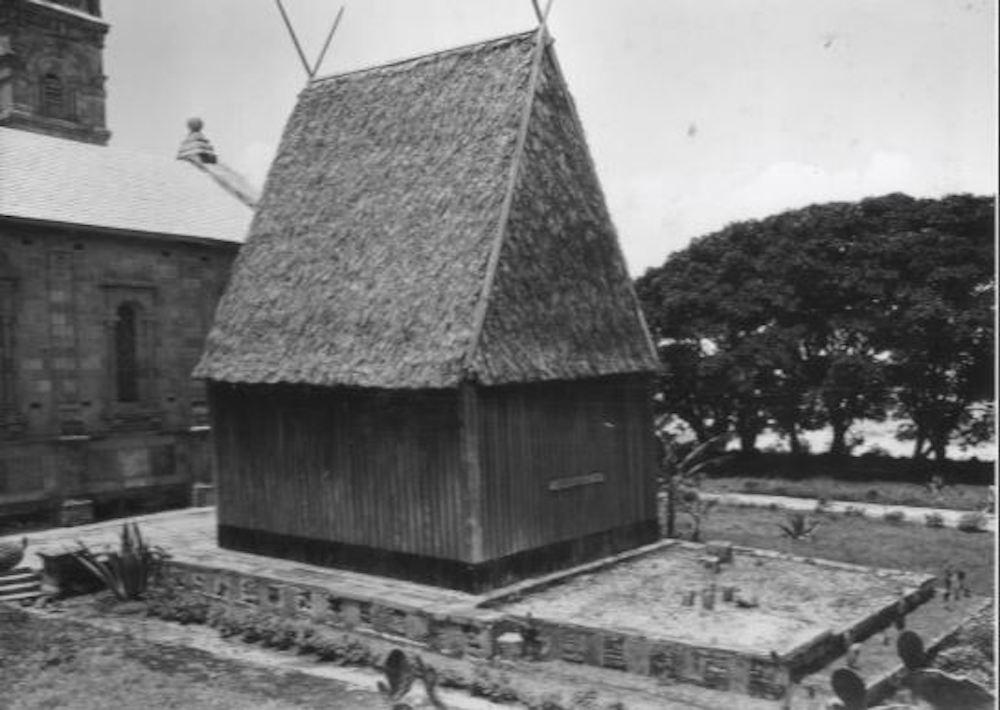
Within the Rova of Antananarivo, there are several enclosures or districts. Next to Besakana lie Voahangy, Bevato, and Bado, the latter located precisely at the corner of the poultry sheds (to the southeast of the enclosure). Mahitsielafanjaka marks its northern boundary.
According to Vincent Belrose Huygues, Callet’s “Tantaran’Andriana eo Madagascar” suggests that the role of the royal wives was not so much to “ensure the sovereign’s lineage as to watch over (‘mitandrina’) the royal talismans and palladiums that were kept in their huts, and to symbolize the Twelve sacred idols.” The most important palladium, “Manjakatsiroa,” is placed at Mahitsielafanjaka in the north, while “Kelimalaza” and “Rafantaka” are located, one in the north and the other outside the Rova to the west (see previous Notes, “Rova of Tananarive, from Andrianjaka to Radama I: an example of aesthetic syncretism in the 19th century”).
In addition to the enclosures reserved for housing, there are various compounds, starting with the “Kianja” (large courtyard, square). In Ambohimanga, it is a holy place within the Mahandrihono enclosure to the west of the holy house; in Antananarivo, it is located to the west of Masoandro, to the east of Besakana, and to the south of the “Tranomasina,” that is to say, in the women’s courtyard. “In reality, it belonged to the Rova of Andrianjaka between Masoandro and Besakana” (Vincent Belrose Huygues, see previous notes).
By building his own Rova north of Andrianjaka’s, Andrianampoinimerina introduced greater complexity into ceremonies and sacrifices, under the influence of Antemoro astrologers.
First, each “place of worship”—meaning each of the houses of the twelve wives and the dwellings of the idols—possessed its own “Kianja” with its sacrificial stone. “Depending on the day, the diviner would indicate a specific corner of the Rova for the sacrifice, whereas under Andrianjaka, all sacrifices were performed in the east.”
The second element not reserved for housing is the “Fahimasina.” In Ambohimanga, the sacred cattle pen is within the royal enclosure, west of the “Kianja” (the cattle moving from west to east for sacrifice). In Antananarivo, “Andrianampoinimerina had built two cattle pens; one, ‘Menalefona,’ is located near Kelisoa: there his bull called Menalefona is kept; the other pen is Ampahibe, west of Besakana: there the ‘sikidy’ cattle and dairy cows are kept” (R.P. Callet).
The “Menalefona” pen does not fit the definition of the “Fahimasina,” but it once again testifies to the importance of “symbolism and astrological practice under Andrianampoinimerina.” The enclosure is situated in the northeast of the Rova. “It is the corner reserved for the Alahamady destiny, a powerful destiny chosen by the sovereigns.”
Now, the sign of Alahamady is the bull. If one adds that “Mena” (red) is the color of the sovereign and that “lefona” (spear, assegai) is an honorary badge, one discovers “all the symbolism attached to the slightest naming of the smallest construction of the Rova,” notes Belrose Huygues. The true cattle pen is Ampahibe, whose location dates back to Andrianjaka, in the southwest corner and perhaps outside the royal enclosure.
The third element is cited by Coppalle (“Voyage to the interior of Madagascar and to the capital of King Radama,” Bulletin of the Malagasy Academy, 1909-1910). “In the west of the palace is a small courtyard planted with trees. This is where justice is administered,” he describes. The “Tantara” do not mention it, indicates the author of the Rova presentation, but the oldest iconography, dating from 1862, reveals its presence at the site of the “royal ficus.”
However, Father Callet points to the existence of a Lapa, “Tsarazoky,” where justice was administered inside the Rova and which was demolished by Ranavalona I. He also mentions another “Tsarazoky,” west of Masoandro, which was the home of the diviner Ramiangaly.
Finally, Andrianampoinimerina established two supreme courts in Ambohimanga and Antananarivo, but they did not sit permanently. The one in Antananarivo met in the “Tsarazoky,” cleared for the occasion, and it was certainly under Radama that a permanent tribunal was installed to the west of the enclosure, sheltered by the trees.
By Pela Ravalitera
Captured & Published at: 2026-07-03 23:42:51 (Madagascar Local Time EAT)
Original Source: https://www.lexpress.mg/2026/07/des-gardiennes-pour-surveiller-les.html