
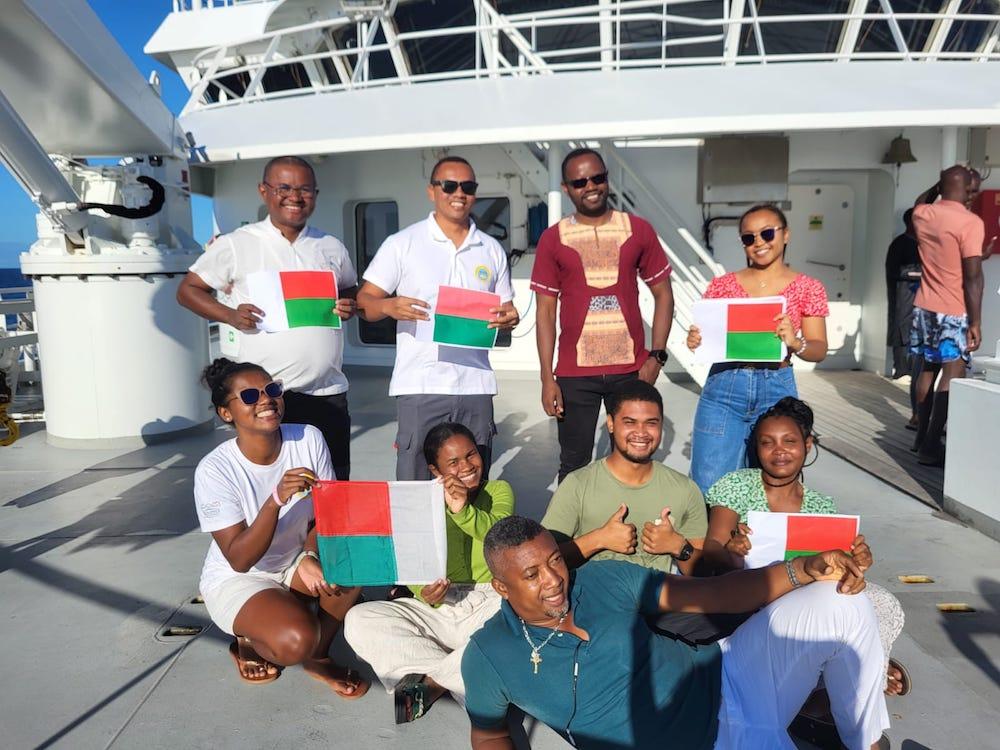
Twenty-four Malagasy researchers are currently navigating the waters of Madagascar’s exclusive economic zone. This scientific campaign is focused on studies, data collection, observations, and analyses.
They have embarked for a two-month journey aboard an oceanographic research vessel. These twenty-four researchers represent the Ministry of Fisheries and Blue Economy, as well as the Ministry of Higher Education and Scientific Research, through the Institute of Fisheries and Marine Sciences (IHSM) of the University of Toliara, the National Centre for Oceanographic Research (CNRO) in Nosy Be, and the University of Anôsy.
This campaign is conducted under the EAF-Nansen programme, implemented by the FAO, in close scientific collaboration with the Norwegian Institute of Marine Research (IMR) and with financial support from the Norwegian Agency for Development Cooperation (Norad).
“Researchers will assess, among other things, the biomass of pelagic and demersal fish, measure essential biological parameters, and characterize the oceanographic conditions of Malagasy waters,” explains Aina Le Don Nomenisoa, a doctor in marine sciences and one of the IHSM representatives aboard the research vessel.
Itinerary
The mission will also allow for the study of plankton, the documentation of the effects of marine pollution, and the observation of marine mammals and seabirds to improve knowledge of oceanic biodiversity.
During the two-month expedition, the campaign is divided into two distinct missions. Eleven researchers will sail along the west coast of Madagascar, from Antsiranana and Nosy Be, before continuing their voyage south towards Mauritius.
“The other team, composed of thirteen researchers, is working off the coast of Antsiranana and will explore the northeast coast up to Vohémar, before sailing along the east coast to the south of the Androy region, covering the southern continental shelf of Madagascar,” the researcher detailed. He noted that foreign researchers are also participating in the expedition.
According to program officials, the collected data will contribute to developing fisheries management policies based on solid scientific evidence, better understanding the effects of climate change on marine ecosystems, monitoring the evolution of marine pollution, particularly that linked to microplastics, and assessing its impacts on biodiversity. It will also help strengthen the capabilities of Malagasy researchers.
Onboard, master’s students and PhD candidates from the IHSM are also participating in the scientific work. The teams rotate in four-hour shifts, from 2 p.m. to 6 p.m., followed by eight hours of rest, before another activity period from 2 a.m. to 10 a.m. “During our break hours, we watch television, sleep, or exercise. Everyone suffers a little from seasickness, especially the first two days, but it gets better afterward,” shares Aina Le Don Nomenisoa.
The ship does not make any stops. It remains at sea for twenty-five days with the first team, before a second team takes over for a seventeen-day mission. Since 1995, the Nansen programme has supported African coastal countries in collecting high-quality scientific data on oceans and fisheries resources to promote the sustainable management of marine ecosystems.
Captured & Published at: 2026-07-01 06:43:12 (Madagascar Local Time EAT)
Original Source: https://www.lexpress.mg/2026/07/recherche-marine-une-expedition.html