
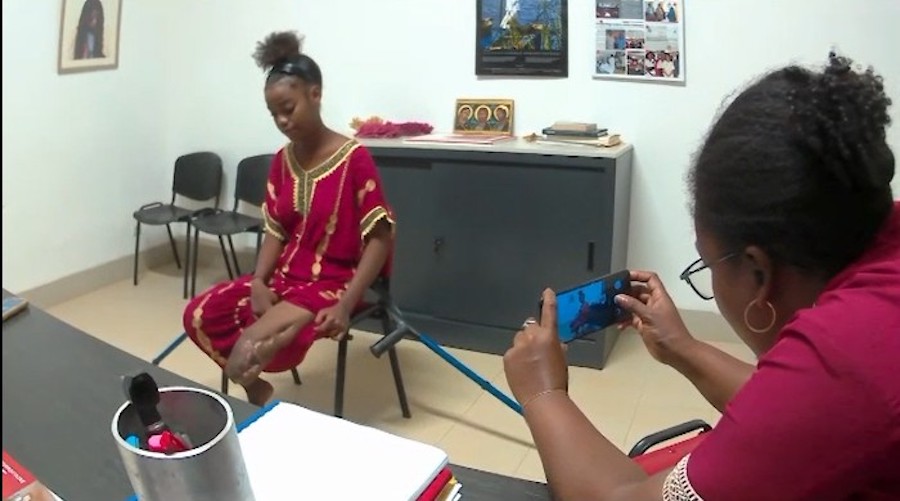
At just 16 years old, Helena saw her life change in a matter of seconds in 2024. A brutal accident, a crushed leg, an impossible medical decision to accept, followed by months of suffering, silence, and uncertainty. Today, this young girl from Antsiranana dares to believe again that one day, she will be able to walk again.
On May 15, Helena underwent a second surgery at the Polyclinique Next. The operation was a success. After four days of hospitalization, she was able to return home. A new phase then began: that of healing, rehabilitation, and waiting.
According to medical explanations, Helena will have to follow a process of about one year before being able to benefit from a fitted prosthesis. This journey promises to be long, demanding, and sometimes grueling. However, this stage brings hope—the hope of gradually regaining her independence and, one day, being able to stand on her own two legs again.
Background
August 9, 2024, will forever remain etched in the memory of Helena and her family. That day, very close to her home, the young girl was violently struck by a 4×4 vehicle. Her body was thrown in pain. Her left leg, seriously injured, immediately bore the marks of an impact of extreme violence.
Transported in an emergency to the Polyclinique Next in Antsiranana, Helena was treated by doctors. The diagnosis was grim: multiple severe fractures in the left leg. Given the state of her limb, the medical team recommended amputation. A terrible, but necessary decision, according to the doctors, to save her life and avoid serious complications.
But how can one accept, in just a few hours, that a 16-year-old child loses a part of her body? For her parents, this decision was unbearable. As Helena was still a minor, their authorization was essential. Devastated, helpless, and still hoping for a miracle, they refused the intervention.
According to available information, the drivers of the vehicle involved in the accident, who reportedly explained the impact as a brake failure, themselves transported the victim to the hospital. But after the family’s decision to resort to traditional treatment, they reportedly withdrew gradually, leaving the responsibility for care to the victim’s relatives.
The family then chose to turn to traditional care. For more than ten days, Helena followed treatments with a traditional practitioner, known in the local dialect as an “Antefagnaigny,” not far from the city.
Painful Period
In the hearts of her loved ones, there was still hope of avoiding the irreversible. But while hope clung on, the disease progressed, the wounds worsened, infections appeared, and the leg deteriorated. The danger became more threatening every day.
“My wounds had turned black and gave off a foul odor. We finally returned to the hospital to continue the treatments,” she recounts.
When the family finally decided to go to a public hospital in the city, the doctors confirmed the gravity of the situation. There was no other option. To save Helena, amputation was mandatory. This time, the parents accepted the intervention. The young girl’s left leg was amputated.
Helena survived, but a different kind of suffering began. She left the hospital with a part of herself missing. The wounds healed, but the internal injury remained immense. At an age where many young people dream of the future, studies, work, and freedom, she had to learn to live with crutches, with the gaze of others, and with the limitations imposed by her body.
“The doctors treated me, but I came out with my left leg amputated. At that time, we had spent more than 3 million ariary,” she confides.
For nearly two years, her life became a daily struggle. Getting up, walking, moving around, leaving the house: every simple gesture became an ordeal. But the most painful part was not just physical. It was also the future, which seemed to slip away. Because over time, her knee locked, making it impossible to wear a suitable prosthesis. Even after the amputation, Helena remained a prisoner of very limited mobility.
For an amputee young girl, a prosthesis represents more than a medical device. It is the possibility to stand, to walk, to work, and to regain a social life. But for Helena, this possibility still seemed inaccessible.
A New Door
At the beginning of May 2026, a new opportunity presented itself. Dr. Thomas Vasters, a German trauma surgeon, arrived at the Polyclinique Next in Antsiranana. Informed of his presence, Helena and her mother decided to consult him. They did not come looking for a miracle, but for a possibility.
After medical examinations, the conclusion was clear: the knee blockage prevented the fitting of a prosthetic. To allow Helena to one day wear a suitable prosthesis, a new surgical intervention was necessary. But this operation involved a particularly difficult decision: performing a higher amputation, above the knee.
For Helena and her mother, it was another shock. Accepting a second amputation meant reliving the fear, the hospital, the pain, and the anxiety. But it also opened the way to a possible reconstruction.
“It was thanks to the advice of our friends and neighbors, who explained to us that she could walk again with a prosthesis, that we decided to come here for this new operation. I only seek the well-being of my daughter. I never went to school, I don’t know much, so I trust the doctors entirely,” confides Helena’s mother.
These words summarize all the distress of a mother. A woman who does not have all the medical knowledge, but who carries one certainty: she wants to save her daughter’s future.
Rebirth
Behind this prospect of rebirth lies the commitment of a mobilized medical team. Another figure also played a decisive role: Dr. Luigi Bellini, founding president of the Polyclinique Next of Antsiranana.
For over 20 years, he has been helping the poorest, most destitute, and most marginalized people in the region. In Helena’s case, he decided to take full and free charge of the costs related to the surgical intervention as well as the medical treatments necessary until her complete recovery.
This gesture deeply changed the situation. For a family already tested by expenses, fear, and years of suffering, this support goes far beyond the financial aspect: it becomes a real opening when the future seemed to be closing.
Today, Helena has not yet reached the end of her journey. She must heal, follow rehabilitation, wait, and relearn how to live with a transformed body. But an essential change has occurred: she is no longer locked into the idea that her life stopped on the day of the accident.
Thanks to this medical and human solidarity, Helena can dream again. She can hope to walk again, gain independence, envision a career, and build a life that is not just defined by her amputation, but also supported by her courage and resilience. For Helena, the path remains long, but now, there is light.
Raheriniaina
Captured & Published at: 2026-06-23 06:30:03 (Madagascar Local Time EAT)
Original Source: https://www.lexpress.mg/2026/06/antsiranana-helena-entame-une-nouvelle.html