
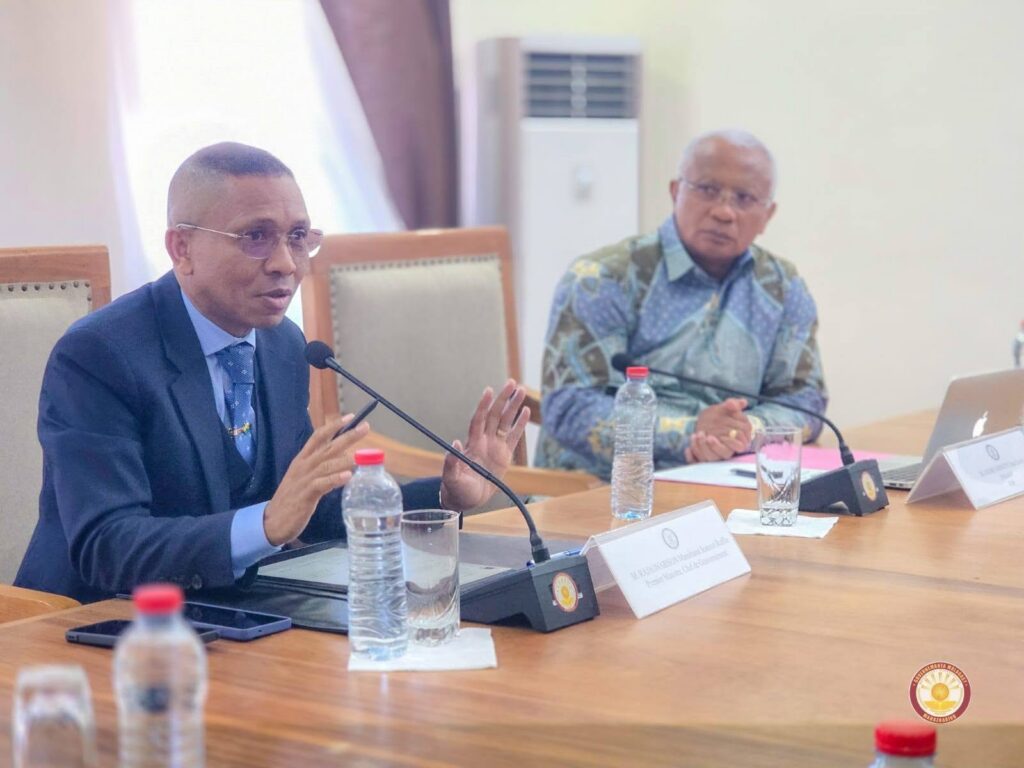
From late June through the end of July, Madagascar will undergo a double evaluation. The first concerns the fight against corruption, and the second focuses on the fight against money laundering.
Immediate succession. Anti-corruption entities, along with those tasked with combating money laundering and terrorist financing, will be under pressure in the coming weeks. The ‘Great Island’ will indeed be the subject of two successive evaluations starting at the end of the month and spanning almost the entire month of July.
The first evaluation, scheduled from June 30 to July 2, focuses on the actions taken by the country to combat corruption, based on the United Nations Convention against Corruption (UNCAC). This is the first global and binding legal instrument for fighting corruption. It requires signatory states to implement standards and laws regarding prevention, incrimination, law enforcement, international cooperation, and the recovery of illicit assets, among others.
The evaluation beginning at the end of the month concerns the mechanism for prevention and the recovery of illicit assets.
“Regarding corruption prevention, the review focuses on the effectiveness of national policies and anti-corruption bodies,” explains the Committee for the Safeguard of Integrity (CSI). Transparency in public procurement, public finance management, and the code of conduct for public officials will be scrutinized.
Evaluators will also assess the integrity of the judicial system and public access to information. The draft law on access to public information, which was supposed to be debated and voted on by the National Assembly during this ordinary session, remains on hold. Concerning the recovery of ill-gotten gains, the country’s operational capacity to detect and block illicit capital transfers will be evaluated.
Still on the subject of the evaluation of illicit asset recovery, the review will also cover legal mechanisms for seizure and confiscation, as well as procedures for returning ill-gotten assets to the State. The role of the Financial Intelligence Service (Samifin), as well as the effectiveness of international cooperation agreements concluded by Madagascar, will also be reviewed.
International and Economic Credibility
Regarding SAMIFIN, it will be at the forefront during the second set of evaluations concerning the country’s performance in the fight against money laundering and terrorist financing. As indicated in the Council of Ministers’ report on Wednesday, evaluators from the Eastern and Southern Africa Anti-Money Laundering Group (ESAAMLG) will be on the island from July 8 to 30.
The ESAAMLG is a regional body similar to the FATF (Financial Action Task Force). It is an international entity dedicated to designing and promoting an international mechanism for combating money laundering, terrorist financing, and the proliferation of weapons of mass destruction. The first part of the evaluation concerns the technical aspect, specifically the adoption of legal instruments necessary to comply with FATF standards.
The second part concerns the operationality and effectiveness of the established anti-money laundering system. Prevention, detection, and enforcement are among the points that will be closely examined. The two evaluations Madagascar will face in the coming weeks are far from mere administrative formalities. Their results carry significant stakes for the country’s international and economic credibility.
Access to the global financial system, international funding, and the country’s economic attractiveness are at stake. Donors and other international financial actors are closely monitoring reports on the fight against corruption. A poor UNCAC evaluation serves as an alarm signal indicating a ‘high-risk country.’ For the ESAAMLG evaluation, the consequences of a poor grade are more concrete.
In the event of a negative evaluation, the country risks being placed on the grey list or the black list. If placed on the grey list, Madagascar will suffer an economic bottleneck, including restricted access to the global banking system. The country would struggle to conduct international banking transactions, which implies difficulties in exporting and importing goods. This scenario could also paralyze foreign investment.
The possibility of being placed on the black list would mean a ban from the global financial system. Having served as the Director-General of Samifin, Prime Minister Mamitiana Rajaonarison is well aware of the stakes of the upcoming evaluations, particularly those regarding the fight against money laundering. This explains why the topic was the subject of a communication in the Council of Ministers, ensuring the entire administration is on high alert.
Captured & Published at: 2026-06-22 06:00:43 (Madagascar Local Time EAT)
Original Source: https://www.lexpress.mg/2026/06/corruption-et-blanchiment-dargent.html