
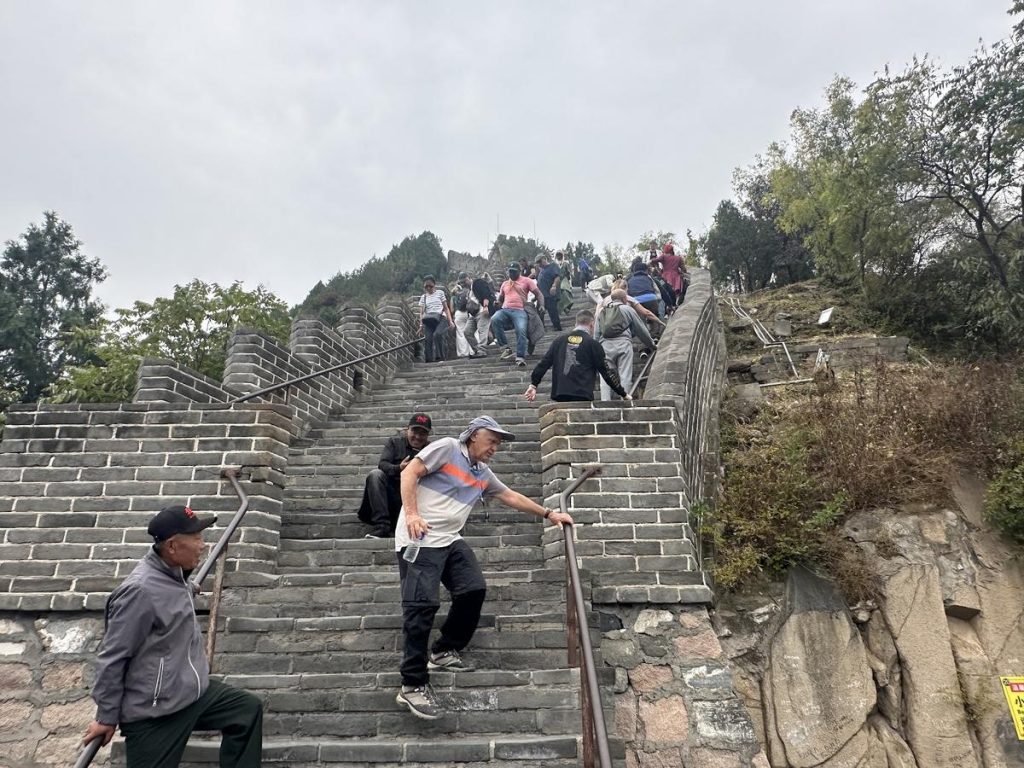
From the entrance of Juyongguan to the heights of watchtower number 12, climbing the Great Wall is as much a physical challenge as it is a journey through history. On these stone steps that hug the mountain ridges, visitors from China and abroad share the same effort, turning this adventure into a profoundly human experience.
Breathtaking. That is the first word that comes to mind when the first sections of the Great Wall of China are gradually revealed amidst the hills of Juyongguan. This fortified pass, located north of Beijing, is set in a mountainous landscape where ridges seem to follow one another to infinity.
The Great Wall is a site whose reputation precedes it so much that one wonders, upon arrival, if the reality will live up to the imagination. It does. Crowned by its millennial history, the site commands respect. The stone walls snake along the mountainsides, following the curves of the terrain and disappearing behind the peaks before reappearing further away. Watchtowers, frozen in time, punctuate this defensive line at regular intervals.
The Great Wall is not the result of a single project, but of successive works undertaken by different Chinese dynasties to protect their territories from northern incursions. Around 220 BCE, Emperor Qin Shi Huang connected pre-existing fortifications to form a more coherent defensive system. Work continued over the centuries, particularly under the Ming Dynasty (1368–1644), during which much of the fortifications visible today were built.
The structure spans over 20,000 kilometers. In 1987, it was inscribed on the UNESCO World Heritage List, and in 2007, it was designated as one of the New Seven Wonders of the World. Today, those who pass through its gates no longer come to repel invaders; they come to challenge themselves against the mountain and immerse themselves in the majesty of the site.
The ascent is a journey through time. The path is measured in steps climbed, necessary pauses to catch one’s breath, and sustained effort. The goal is to reach watchtower number 12, located at an altitude of about 615 meters. While the western loop of Juyongguan is over four kilometers long, the steepness and irregular steps make it a significant personal challenge.
Beyond the individual struggle, the climb is a collective experience. On the steps, visitors of all ages and nationalities cross paths. A look of encouragement or a spontaneous gesture of help breaks down barriers. In this space steeped in history, cultural differences seem to fade, as everyone shares the same goal: to reach the top and see what lies beyond the next ridge.
At the end of the climb, when tower number 12 finally appears, a sense of accomplishment takes over. Journalists from around the world, participating in a program organized by the China International Press Communication Center (CIPCC), joined other tourists in this endeavor. As Sam, a retiree from Dallas, noted, the experience is about more than just the summit; it is about discovering a historical monument and sharing a positive, euphoric atmosphere with fellow travelers.
Conquering the Great Wall does not mean dominating the mountain or breaking a record. It means finding one’s rhythm, recognizing one’s limits, and pushing past them. Visitors leave with tired legs, but enriched by the memories of a cultural and human experience, having had the privilege of walking on stones charged with a thousand years of history.
Captured & Published at: 2026-10-14 06:24:07 (Madagascar Local Time EAT)
Original Source: https://www.lexpress.mg/2026/10/carnet-de-voyage-la-conquete-de-la.html