
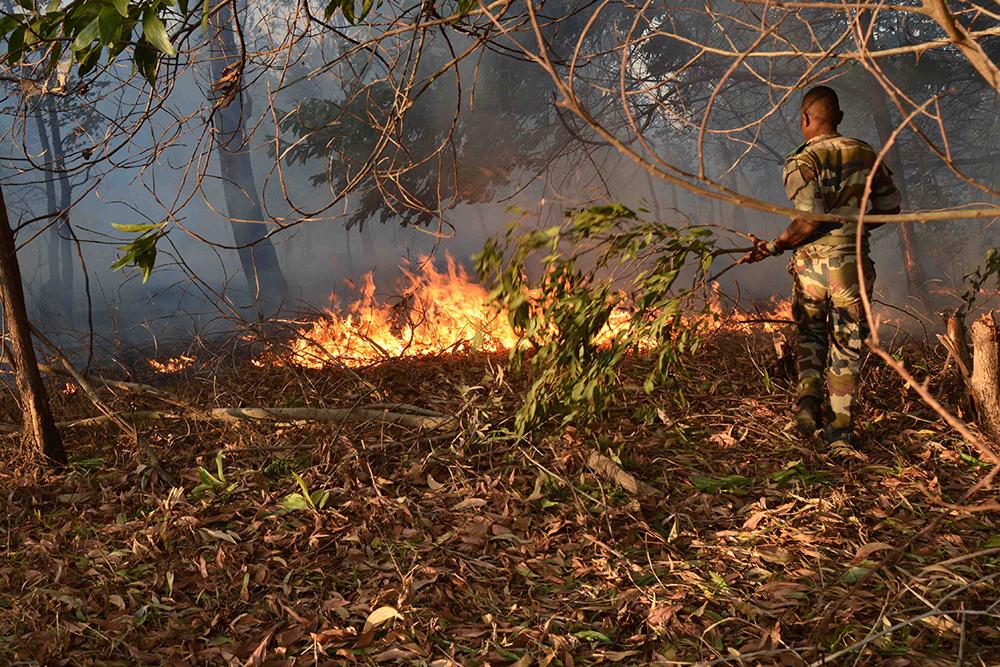
Several rural communes in Antsiranana-II and Ambilobe are being hit by a series of fires. Negligence and risky practices are among the primary causes.
Bushfires are currently gaining ground in the districts of Antsiranana-II and Ambilobe. From the west to the mid-west, passing through the south and north, several rural communes are affected by this phenomenon, which causes significant environmental degradation and material damage.
In these two districts, devastating fires break out every week. Hundreds, if not thousands, of hectares of vegetation go up in smoke each year. These fires degrade the soil and contribute to the disappearance of local fauna and flora.
This year, the resurgence of bushfires makes the situation particularly alarming. Forests, including those in natural parks, savannas, and the wild species that inhabit them, are particularly threatened.
According to field observations, the Antsiranana-II district is regularly confronted with bushfires. This year again, the month of September is marked by a peak in fires, with a succession of blazes recorded over the span of two weeks in several rural communes.
“We are indeed in a peak period. Every week, bushfires are reported,” indicates the Regional Director of Environment and Sustainable Development (DREDD), Irina Mohajy. The phenomenon, initially observed in certain areas of the Antsiranana-II district, has gradually extended to Ambohipiraka, in the Ambilobe district.
Faced with this multiplication of fire outbreaks, the Joint Conception Body (OMC) met to examine the measures and strategies to be implemented to better prevent and fight fires before they cause further damage.
The identified causes are diverse and, in many cases, stem more from negligence or accidents than from a deliberate desire to burn natural spaces. In Ambilobe, for instance, a fire reportedly started from a hearth left unattended by young cattle herders, locally known as “Tsimanaja,” who were roasting cashews, or “mahabibo,” for their meal. Upon leaving the site, they allegedly left active embers behind, which then ignited the dry vegetation.
In Andranotsimaty, another fire reportedly began following embers blown from a hearth used to prepare a meal in a courtyard. Carried by the wind, these embers reached dry grass and triggered the fire.
More recently, a fire in the rural commune of Sakaramy illustrated the potentially heavy consequences of certain practices related to charcoal production. The fire affected homes and over forty businesses before spreading to a thousand hectares of forest and savanna.
Other fires are linked to the clearing of agricultural plots by burning. Some farmers carry out these operations at night. However, under the effect of trade wind gusts, sparks and embers can be carried to neighboring areas and quickly ignite dry grass, making the fire difficult to control.
In certain traditional livestock practices, the burning of pastures is also used to try to fight parasites affecting cattle. When the fire escapes the control of those who lit it, this practice can become a real threat to natural spaces and homes.
According to explanations gathered from environmental officials, the bushfires observed in the two districts are not systematically intentional. Negligence, certain agricultural and pastoral practices, as well as the failure to observe basic precautions are among the factors cited.
Added to these causes are the behaviors of passersby, which are more difficult to control. Cigarette butts thrown on the ground without precaution can, when conditions are right, cause a fire to start. The multiplication of fires in September thus underscores the need for increased vigilance, public awareness, and more rigorous control of risky practices.
Captured & Published at: 2026-10-01 06:23:35 (Madagascar Local Time EAT)
Original Source: https://www.lexpress.mg/2026/10/region-diana-les-feux-de-brousse.html