“Students gaining study hours after dark, more reliable and better-equipped health services, emerging economic activities, and new prospects for entire rural communities.” The United Nations Development Programme (UNDP) hopes that the new solar photovoltaic power plants installed in Antsiafabositra and Beanana, in the Maevatanana district, Betsiboka region, will gradually transform living conditions and the local economy.
The two infrastructures, inaugurated on Friday, have been connecting 548 households and 31 public and community facilities in these two localities for several months. With a total installed capacity of 140.8 kWp and over 300 kWh of battery storage capacity, they power more than 12 kilometers of grid and serve over 2,700 inhabitants. Beyond access to electricity, the project aims to create favorable conditions for the development of new economic activities in these two rural communes.
According to the UNDP, nearly 50 economic activities have already been created around the grids. The availability of more regular electricity should allow small businesses to extend their operating hours, use electrical equipment, or develop new services. For both communes, the challenge is also to leverage energy to strengthen public services and income-generating activities.
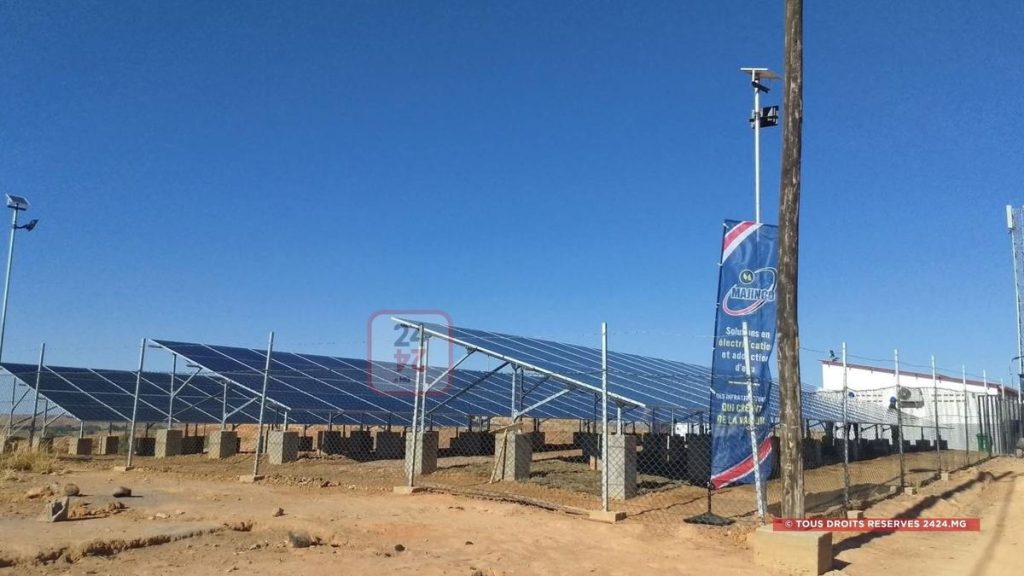
In Antsiafabositra, the plant has a capacity of 90.2 kWp, with 164 solar panels of 550 Wp, two 45 kW inverters, and a storage capacity of 230 kWh. This configuration allows for up to three days of autonomy. The grid extends over 6.6 kilometers, including 1.2 kilometers of medium voltage and 5.4 kilometers of low voltage. In total, 393 households, 17 public buildings, and 42 small businesses are directly connected to the infrastructure. 56 public lighting points have also been installed. The cost of the work is over 2.333 billion ariary.
In Beanana, the plant has a capacity of 50.6 kWp, with 92 solar panels of 550 Wp, four 10 kVA inverters, and 82 kWh of batteries, providing up to two days of autonomy. The low-voltage grid covers 3.4 kilometers and includes 28 public lighting points. The installation allows for the connection of 238 households, 14 public infrastructures, and six small businesses. The investment amounts to 1.605 billion ariary.
The two infrastructures were built by the company Majinco as part of the joint United Nations program “Integrated Financing for Sustainable Energy” (Fier), supported by the UNDP, UNIDO, UNCDF, the SDG Fund, and Majinco. Funding is provided 53% by the UNDP and 47% by Majinco. The project relies on a performance-based payment mechanism, deployed through the UNDP’s risk reduction facility, to facilitate the mobilization of private investment in rural electrification.
In Antsiafabositra, the new infrastructure comes after the end of a previous electricity supply contract, following 15 years of operation. Majinco was selected following call for projects No. 6 launched by the Rural Electrification Development Agency (ADER). The partnership contract, signed on March 31, 2026, is for a duration of 25 years. Work began in November 2025 and was completed in May 2026.
Captured & Published at: 2026-09-20 18:38:34 (Madagascar Local Time EAT)
Original Source: https://www.2424.mg/electrification-rurale-un-nouvel-elan-economique-et-social-attendu-a-antsiafabositra-et-beanana-grace-aux-centrales-solaires/