
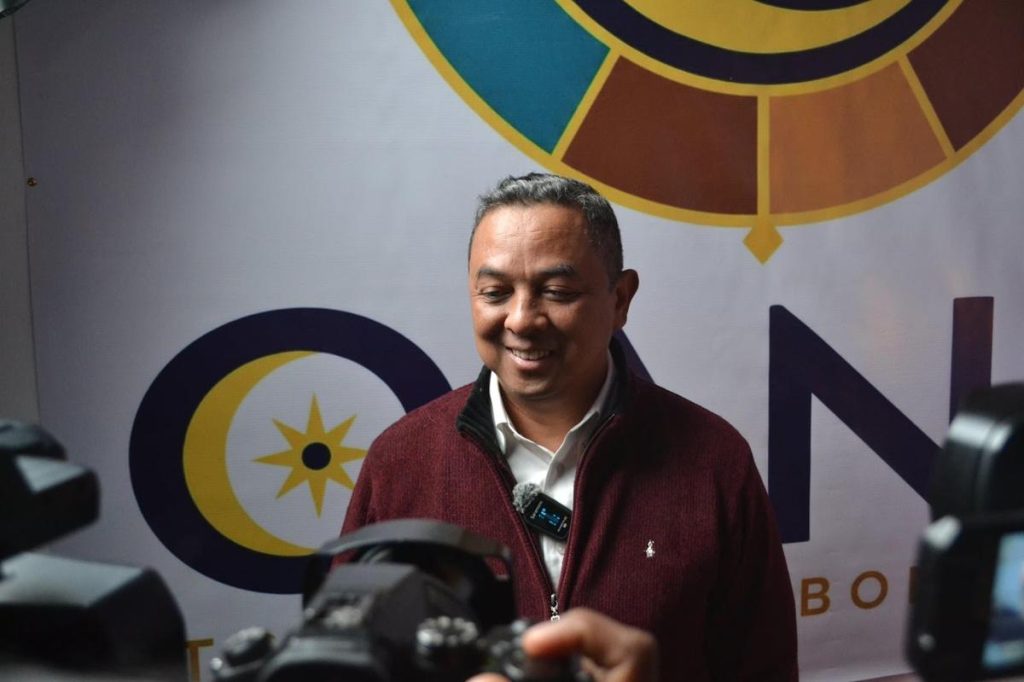
The OANA application was launched yesterday at 3.14 Antaninarenina. It combines traditional knowledge, cartography, and artificial intelligence to offer a new way to explore Fanandroana.
Whether choosing a day, analyzing a location, or consulting birth-related indications, Fanandroana is now available on screen with the OANA application. Presented by the 3.14 team, this platform aims to make this traditional knowledge more accessible in a modern format, without replacing the mpanandro (astrologer), especially for rituals and ceremonies.
In Malagasy culture, Fanandroana involves the study and interpretation of days and ‘vintana’ (destiny) to determine favorable or unfavorable times for specific activities. It is traditionally used in various aspects of life, such as ceremonies, travel, house construction, and even the opening of cemeteries.
The OANA application is structured around six sections. By entering their name, date, and time of birth, users can access information across several domains. Two modes are offered: a simple consultation and an in-depth approach for users more familiar with Fanandroana.
According to its designers, the name OANA refers to Malagasy terms that can evoke opposite meanings, such as ‘there is’ and ‘there is not’. The goal is to transmit ancient knowledge in a new way and make it more accessible to younger generations. ‘Fanandroana is presented in a modern form,’ the team summarizes, while maintaining the role of the mpanandro in traditional practices.
The ‘Anio’ section presents the day, the sun’s position, and activities considered favorable or discouraged in various areas: tradition, commerce, work, repairs, travel, or ‘fady’ (taboos). ‘Daty’ allows users to consult dates through a calendar with their specific indications.
‘Mahomby’ allows users to search for dates based on different situations, including direction, studies, commerce, business, marriage, health, or traditional practices. Results can be saved, compared, and stored.
With ‘Za’, the application integrates a map featuring approximately 600 sacred sites in Madagascar, as well as important locations in Mauritius and Reunion Island. It includes villages, historical sites, ‘doany’ (sacred places), information on ‘fady’, GPS coordinates, and various elements related to the characteristics of these places.
OANA integrates Lumina, presented as an artificial intelligence specialized in Fanandroana. Lumina can assist with certain projects and answer various questions, such as house organization, by suggesting orientation, room placement, and layout. Geolocation provides information on a location and its potential uses, including 3D projections.
The application’s design is the result of several years of research, documentation, and study of Fanandroana. The team indicates they worked with several mpanandro and studied knowledge from different cultural groups. Fetra Razakadera emphasizes that this project has been long-awaited, allowing the team to ‘fully showcase the richness of Malagasy culture.’
Captured & Published at: 2026-09-18 06:09:12 (Madagascar Local Time EAT)
Original Source: https://www.lexpress.mg/2026/09/numerique-lintelligence-artificielle.html