
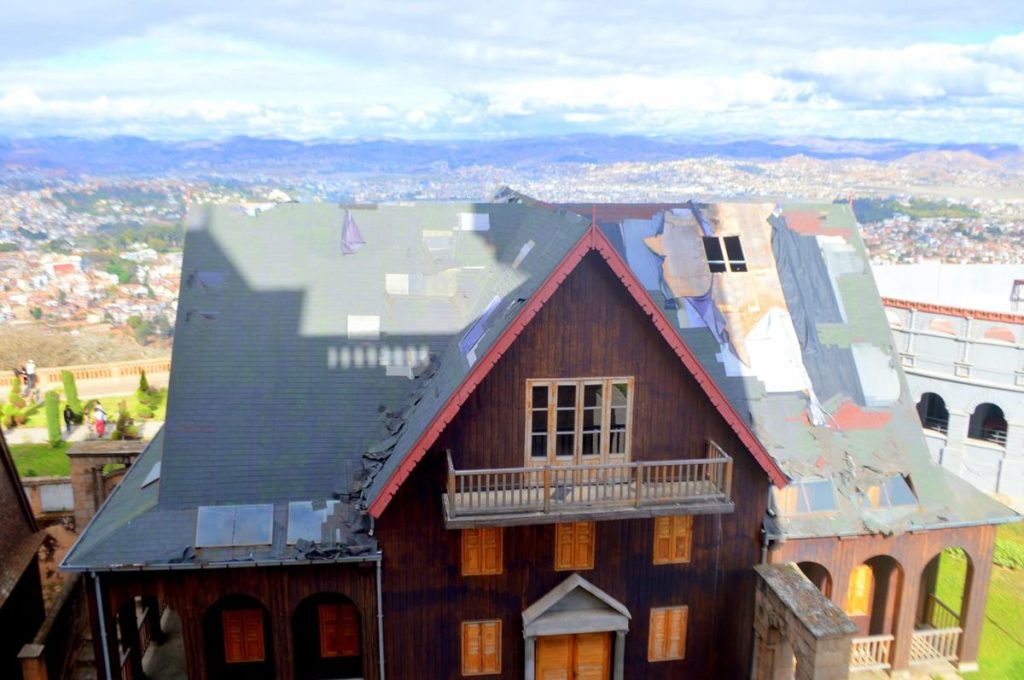
A few years after its reconstruction, the Manampisoa Palace is showing new signs of deterioration. Damage to its roof, exacerbated by the passage of Cyclone Gezani, has led authorities to prepare for a new restoration and to re-examine certain choices made during previous works.
At the heart of the Rovan’i Madagasikara (Queen’s Palace complex), the Manampisoa Palace is currently showing several signs of degradation. Its slate roof is notably damaged in places, exposing parts of the building to the elements. The winds associated with Cyclone Gezani have worsened the situation. Beyond this recent damage, heritage officials are also questioning certain aspects of the reconstruction carried out a few years ago.
Entirely built of wood, Manampisoa belongs to an era when stone and brick, considered “dead materials,” were still forbidden in Imerina constructions. The original building had stood for nearly a century. The more recent reconstruction, carried out under the mandate of former minister Lalatiana Andriantogarivo, is already showing signs of degradation on some of its elements after only a few years.
Faced with this situation, the Office of the Rovan’i Madagasikara (Ormada) indicates that a restoration file is in preparation. A technical study is currently being conducted by engineers to assess the state of the building and determine the necessary work. “This is not a forgotten file. Manampisoa is one of the ministry’s priorities. We cannot announce a precise deadline, but we want to see progress, even if it is gradual,” explains a member of Ormada.
According to the Office’s officials, the ministry had been alerted to the state of certain buildings even before the recent circulation of images on social media. An initial study had been carried out and a project developed. A budget had also been planned, but its status still needs to be clarified.
“We must first clarify where the money went before going any further,” states Ormada. The file has already been presented to the Council of Government.
However, the concerns do not only relate to the roof. “The real problem is not just the holes in the roof. It is the very architecture of Manampisoa that is being questioned, as it does not respect architectural standards,” notes Ormada.
A new study should allow for a more precise determination of the extent of the damage and the necessary interventions. An expanded scientific committee is also expected to be set up to support the next steps, particularly in the choice of wood and other materials.
The Ministry of Communication and Culture also reports questions regarding certain choices made during previous works. “The problem mainly concerns the way the work on the Manampisoa Palace was carried out,” explains a member of the ministry.
Some elements of the building, including the staircase, were reportedly built differently from their previous configuration. According to the officials interviewed, expert recommendations were not always sufficiently taken into account during the reconstruction.
The issue of materials is also among the points being examined. “We must, as much as possible, respect authenticity. If the roof was slate, we must use slate of the same quality,” the ministry continues. The durability of the wood used during the reconstruction is thus one of the elements that must be evaluated, with officials believing it might not have the same characteristics as that of the old building.
The ministry now indicates that it wants to determine the most appropriate methods for a new intervention and bring the restoration back into compliance with heritage conservation principles.
The question of funding remains decisive. A budget had been planned for the work but was ultimately not committed. A request must be presented to the Council of Ministers to obtain the necessary means for the restoration, a process scheduled for September. Exceptional resources from the Ministry of Communication and Culture could also be mobilized.
Once funding is obtained, its mobilization will have to follow public finance procedures. Before the start of the work, the scientific committee must also be convened to precisely define the restoration methods for the palace.
Like several buildings in the royal complex, Manampisoa was affected by the 1995 fire that ravaged part of the Rova, including the Manjakamiadana Palace. Its reconstruction began in 2022.
The new degradation today revives the question of the long-term conservation of the reconstructed Rova buildings, from the choice of materials and techniques to their maintenance and monitoring.
Captured & Published at: 2026-09-15 06:08:35 (Madagascar Local Time EAT)
Original Source: https://www.lexpress.mg/2026/09/patrimoine-le-palais-de-manampisoa-se.html